Showing posts with label training. Show all posts

Tuesday, February 18, 2014

Sick!


In my previous blog I spoke about being Walloped by Winter and what to do about it. The Winter season is also when Cold and Flu season peak. I'm not sure about you, but for me, I am typically felled by one garden-variety head-cold each winter. Seems par-for the course.

For endurance sports athletes, it presents a bit of a challenge. How do you beat the cold, and get back to normal ASAP? There is that gnawing worry about the down-time and the lost fitness.

Years ago, when I was much younger and perhaps not as wise, I used to push things and not listen to my body. I would ignore the early signs of the cold coming on - the body aches, the weakness, the head or chest congestion. Then it would hit in all it's fury - down for a few days, but then I would rush the come back, and the cold would then drag on for sometime with remnant symptoms hanging around for weeks.

Two events changed my views on getting sick in this way.

One time before my biggest triathlon race of the season, I came down with a head-cold just over a week out from the race. It was a doozy - sent me to bed for a few days. I was then wrestling with what to do in the run-up to the race. I chose to do nothing - no training at all. All tolled, when I toed the starting line, I had done no training for a full week. I did not feel that great physically, but that race ended up being one of my best races of the year! The one week sick-with-a-cold taper in full-effect! Lesson: A week of resting and recovery from a cold, does not impact your fitness.

The other event was more sinister. I came down with a really bad chest cold. It was very bad. I thought I had recovered and I jumped right back into training at a high level. I had a relapse, that morphed into full-blown pneumonia. This really knocked me out. Close to being hospitalized. Had to take 3 weeks off work. Two of which were spent at home in bed.

Follow-up x-rays and testing discovered that I had done some permanent damage to my lungs - perhaps losing as much as 25% of my absolute, lung capacity. Disturbing news for an endurance athlete. However, I was advised that the lungs can over-compensate and some of this 25% deficit could be taken back and the loss not noticeable.

Lesson here - listen to the body. Take the time to recover fully, before resuming heavy training!

In summary - when you get sick with a head or chest cold, just take the time to fully recover. Recent, studies have shown that despite what all the cold-medication companies tell you, nothing that you can take will make the cold go away any quicker. The OTC drugs, just make some of the symptoms easier to cope with. In short - rest and relaxation and letting the body fight and deal with the infection as best as it can,  is the best thing to do, and for the endurance sports athlete that means stopping training until you are 100% recovered and ready to go. When you get those early symptoms - the weakness, the body aches etc . . just shut it down and get as much rest as you can. Help your body help, itself!

On the defense front - the old fashioned way of frequently washing your hands, has been proven to be the best defense from getting sick in the first place. It's far better and more effective than many rumored methods that people talk about. Many of the more popular defense methods - over-dosing on Vitamin-C,  taking echinacea etc . . have proven to have little to no effect on cold prevention! Eat a healthy and well balanced diet, and you should have all the natural disease prevention and immunity that you'll ever get. Also, make sure you are getting enough sleep. Recent research has concluded that sleep, is the #1 recovery tool for your body.

Again - wash your hands. And if you do get sick, don't panic. Just take the down-time to rest up a recover well. Know that under normal circumstances your garden-variety head or chest cold runs it's course in a week to 10 days, and there is really not much you can do about that other than doing nothing at all!

Have you been sick this winter? How did it go?

If you like what you see here, please feel free to share this blog with your preferred sharing app from the buttons below:

Thursday, February 6, 2014

Walloped by Winter! What Are You Doing?


I saw a map this week online. It showed that  2/3 of Canada & the U.S., ie most of the North American continent, was covered in snow. I know that for almost all of Canada (save for the lower-mainland of B.C. and Vancouver Island) - that's normal. The snow-cover and deep cold has also extended much farther south in the U.S. than "normal" this winter.

We've been walloped by winter, actually. In my area, just north of  Toronto, ON, after a number of rather benign winters, it's been full-on this year with, from what I can tell,  record snow-falls and, the coldest average temperatures in over 10 years. For endurance sports athletes who for the most part train outside - runners, triathletes, and cyclists, it's been challenging to keep the training going. How have you been coping?

I've always had two views on this - you either take it inside, and shun winter as much as you can, or you embrace it, and make the most of it.

For the Shunners, the solutions, are obvious: For the triathlete - swim/cycle/run, can all be done indoors. If you are into this, and have access to the right facilities and equipment, in a perfect world, there can be minimal interruption in your training. True - the cycling and the running, on indoor trainers and treadmills can get a little tedious, but videos can be a great distraction and some of the interactive, computer driven indoor bike training set-ups are truly extraordinary! If you are just a runner or a cyclist, just plug into the above.

For the Embracers - the great outdoors can really open things up. Full disclosure - when I was training seriously for triathlon this was my approach. I was never a fan of the treadmill or the indoor bike trainer. What did I do?

First - I never stopped running outdoors. In fact, winter is when I would lay down the most overall volume of miles running. With the right apparel and attitude, you can run in just about any kind of weather, anywhere. Sure the footing, was lousy, the deep snow sometimes slowed you down, and the wind would force your pace to a crawl. Note the word "volume" back there - that was the focus . . not speed, pace or time. Just get the miles/K's in!

Second - I cross-country skied . . . a lot. Both classic and skating. Nordic skiing is the king of aerobic sports - it works more muscles in the body than any other single activity - upper body, lower body, core etc . . It all get's worked. When I had a great winter of skiing - where I put in the biggest volume of skiing and took my skiing to the highest level of performance, I noticed two things: 1) My cycling and triathlon performance the following summer was always better. 2) Despite very little cycling through Dec/Jan/Feb, come March, after just a few weeks of riding, I could ride 100K at a decent pace with very little ramp up!

Third - I did not eschew the indoor training completely. I would get in the pool maybe ounce a week, just to keep in contact with the feel of the water. I would also get on the indoor bike trainer, and would do one or two very high intensity sessions a week, lasting no more than 60 minutes. As to the latter, they say that even for the cyclist, who just rides, the time on the trainer in the winter, is better spent with a focus on higher intensity, power based riding, than slogging out long sweaty sessions on the trainer. These days, I only ride, and that's my focus: 3 - 4 very specific high quality session on the bike, and never more than an hour. Plus some cross country skiing mixed in.

As a Canadian, I've always had to put up and deal with a winter of some kind. It's part of being a Canadian, in my view - that's why I have always embraced winter. The Winter Olympics are about to begin, and I've found a great deal of truth, honesty and inspiration in the Canadian Olympic Committee official hashtag for the Canadian Olympic Team - #WeAreWinter.  For Canada and Canadians it's perfect!

Do you shun or do you embrace winter? What's your strategy to coping with this real winter we are having this year?

If you like what you see here, please feel free to share this blog with your preferred sharing app from the buttons below:


Wednesday, September 25, 2013

Race More?

 Recharge with Milk Wasaga Beach Triathlon Finish-line - Photo http://www.mysportsshooter.com

I was about to embark on writing a blog straight-up, about the benefits of racing more, for triathletes. I was and still am of the belief that many problems and challenges that the modern triathlete encounters, in races, particularly longer distance triathlon races, could be over-come in part, by racing more.

Then, two things happened:

1. I attended a local social event in my area where over 30 triathletes, many of whom I knew personally, were in attendance. As some know, I work as a Race/Event Announcer almost every weekend at triathlons, running and cycling races. As I stood there in the room filled with triathletes, I realized that I had not seen any of these athletes, with the exception of one, at a race all year!

2. The following day, I asked the question, "Why doesn't the modern triathlete race more?" on my Facebook page. There were an enormous number of responses - some very detailed and informative. You can see the thread of responses here. It's a good read.

Both of these previous points, caused me to re-think things a bit.

From reading the Facebook thread, it's clear that these days, time and costs are the key things that limit the number of races that triathletes do each year. There is no question that races are getting more expensive - for obvious reasons: The costs to put these races on have gone up substantially. As for the time issue, if you look at the largest age-groups in the sport, most active, modern triathletes are right in the middle of their key child-rearing years with 1, 2, 3 or more young kids at home, and also at a time in their careers, when time-on for work, is at it's highest. Add all that up and, and it makes sense why, the modern triathlete races less now, than a previous wave of triathletes did 10+ years ago.

I still believe that many triathletes, particularly newer athletes, in the sport for four years or less, would benefit greatly from more frequent racing. I am backed up on that point by some of the leading local coaches, who also feel the same way, but are pushed back on this, by the athletes they coach. Knowing this, and reading the responses on my Facebook posting, one wonders where the cart and horse are with this. Many athletes want to get better. They want to go faster. A proven way of doing this is to race more frequently (within reason, of course).

Which leads me to what is the definition of a race? My sense is that for many modern triathletes , their definition of a  "race" is a big production + long distance triathlon = expensive.  However, not all races have such big production, and there are certainly many shorter race options (and are hopefully less expensive). Despite what athletes think, these outings can be very helpful and valuable experiences in their overall development.

Also there are "other" racing options - standalone, running, cycling, and swimming events, that again, can be if you look around, not terribly expensive and time efficient. As an example, many local cycling clubs, offer weekly time-trial races, that for club members cost from nothing to a few dollars (with club membership). While not a triathlon race, these standalone races in individual sports can provide great feedback, and serve as outstanding training efforts for the triathlete. Some of these are mid-week, and because of their short and brief nature, can take up less time, than a "normal" triathlon training session.

What do you think? What is your definition of a "race"? Knowing that racing more, will make you better/faster, is that something that you would commit to?

If you like what you see here, please feel free to share this blog with your preferred sharing app from the buttons below:
Thursday, January 3, 2013

Train With Better People

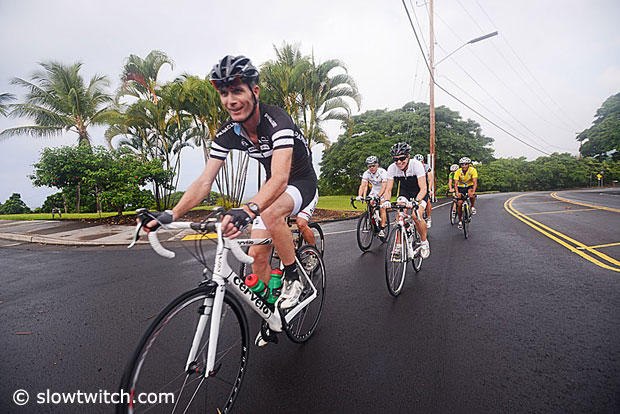
Group ride in Kona, Hawaii heading to the Kaloko climb. Picture - Tim Carlson/Slowtwitch

I've been lucky. All the way along, whether I was a runner, a triathlete, a cross-country skier or a cyclist, I have always had the opportunity to regularly train with people better than me. . . in some cases a lot better than me! I believe that to a large degree, this has been an important part of the, "success" that I experienced along the way, no matter what I was doing in endurance sports.

It's not all absolutely worked out that way. It took me a number of years to figure out the dosing on this. For example, when I was a runner, of some note back in my teens and early 20's, I ran with these better people almost every day. Every workout, particularly hard intervals sessions and tempo runs was like a race! In fact, I probably had some of my best "races" in workouts! Even easy days, were hard!

I recall one session of 7 x 800m intervals on the track that was a 5000m race simulation workout that, was run at a pace way over my head, with a rest session much too short for me to recover. This was a group of  eight or nine strong runners that included, Provincial and National team champions, and team members. Never-the-less, I grimly hung in there, and when my turn to lead, in the lead rotation, came up on the 2nd last interval, I was able to hold the lead all the way, and nail the pace and the 800m split to the second . . . nearly killing myself in doing so. I some how managed to survive the absolute last 800m, but was well off-the-back of  the group in the final 100m. I never duplicated that, "performance" in an actual 5000m race!

As I moved onto triathlon, the situation was the same - regularly training with the absolute best people around in my area and nationally. Ditto with nordic skiing - which became my winter "off-season", from triathlon, but also involved some mammoth ski training, again, often with really good skiers. However, now I was starting to understand better my own needs for periodization - when to load it up and when to back off. When to go hard and long with the group, or when to go easy and do my own thing.

However, it was not just the red-line on the rivet training that, is impactful when you train with really good people, often it's the little things you notice about a world class athlete: How they move? What they wear? What they look at? What's important to them . . and so on.

I have mentioned here before about riding with former Pro Cyclist Alex Steida back in the early 90's in Vancouver. Sure, the riding with Steida was fast, but when you sat on his wheel or road beside him in the group, it was, how at ease he looked no matter what we were doing, that I always noticed. The reach back to grab an energy bar out of the rear pocket of his cycling jersey. Having a drink of water from a water bottle - it all had this extraordinary economy to it all. Grace and calm under pressure!

I recall a run at Christmas time one year in Victioria, BC, with Peter Reid who had just won the first of his three Ironman World Championships two months before, and a young Simon Whitfield, who was just over a year away from winning the first ever Olympic Gold Medal in Triathlon at the 2000 Sydney Olympic Games. The pace for the 16 K run was decent, but not overly fast - in fact Reid had advised us that we had to run "slow". The conversation, was non-stop, and, almost never about training or triathlon! Light and easy. I learned a lot from that run.

Today, my best days as an endurance athlete are far behind me. I don't race much, if at all. Cycling is my thing now. Again, I am lucky in that when I do go out for a group ride, with our local cycling club, the group is peppered with some impressive talent with some of the best Master's cyclists in the province, and in all of Canada! Just hanging in with these guys, and not getting dropped is an achievement and an honor!

Some seek the solitude of solo training. I do too. This quiet time away from everything, I have always found helpful - in many different ways. The trick as I mentioned, is balance. When I was a teenager, running, it was unbalanced towards the side of too much, group training at too high a level. Later on, I realized, how to better balance it all, to get full advantage of the opportunities that training with other better athletes would give me.

The higher level message and take away here is that there is a lot to be gained and learned from training with people who are better than you. I know that I have benefited from it, greatly over the years. Probably did a bit too much of it when I was runner, and had a more balanced approach with it as I got older. But, perhaps I would not have run as well as I did, or developed the massive base of fitness that all that running did for me had I not run like that for 5 - 6 years. Hard to know.

Used properly, group training with better athletes can be highly effective in bringing out the best in you. Don't shy away from it.

Do you train with better people?

If you like what you see here, please feel free to share this blog with your preferred sharing app from the buttons below:

Thursday, September 6, 2012

What a Week? And a Tale of Temptation!

The shocking revelations in the sport of cycling just keep coming. What a week it's been? Of course if we had really been paying attention, we would have known or suspected much of this, so really it should not have come as much of a surprise.

Everyone has their limits. Real competitive sport at the elite high performance level is ruthless - endurance sports like cycling, particularly so. You either keep up . . . or you don't! When you reach that personal limit, when you know you have trained as absolutly as hard as you can and you still can't keep up, or perhaps the podium, is only a few minutes, seconds or steps away . . . . then what?

Maybe I was lucky. I always trained with guys who were a lot better then me - first in running and then in triathlon. Early on in the game, I knew that despite all the training, despite all the hard work, even though we did all the same work outs, there was no way I was going to beat the better guys that I trained with. Call it defeatist if you like. To me it just seemed to be reality.

In the early '90's, I was deep into triathlon. I had come close to breaking 9 hours for the Ironman a couple of times. I was training what seemed to be a crazy amount - kept wondering, if this was my limit. Had a reached the point of taking this as far as I could go? Nine hours at the time was an OK time, but to really break-though, you needed to go sub-9 to be taken seriously. Some potential sponsors had even said, "Call me when you break 9"!

Around that time, I was working out at a local gym and fell into conversation with a coach (note he was not a triathlon coach, but a strength coach who worked out of that gym) who I knew, and helped athletes with strength training. He said to me in a quiet moment of conversation one day, straight-up, that I would be the perfect candidate for a low dosage steroid program. Super-lean (read - skinny-bean-pole) endurance athletes like me, did well on these programs. It allowed us to recover quicker from really hard workouts and made us overall more durable. Meaning, able to train more at a higher level, and then go faster. There was no testing at all in triathlon, the coach said. It was the ideal situation, he concluded!

It could have been that easy for me. In Canada at the time, we were still reeling with the hangover from the Ben Johnson Seoul Olympic Games debacle. Taking steroids, was a no-no. I soon moved, never went back to that gym and never saw that coach again. I did not succumb. I continued to believe that, I could be my best, and get that sub-9 Ironman time, on hard-work and hope.

I tried a few more times, but the sub-9 Ironman remained elusive and by the mid-90's, I had moved onto others things and after my son was born in 1997, gave up on the sport at a competitive level completely.

Given all the news and the revelations this week, I keep thinking back to those days in the early 90's, and that conversation at the gym. How beat-up, battered and fatigued I was after heavy training, and how one conversation and the outcome could have changed everything.

Not making excuses for professional cyclists, but the pressures right through the peleton that they face, would I assume be significantly greater than what me, the sub-pro triathlete was facing in the early 90's. However, everyone will reach their limit, and when they reach that point, knowing realistically, that just more years of hard work is not going to do it, that's perhaps when you reach that junction in the road - one road, is more hard work, but you know not much is going to change. The other road, is to seek some form of outside illegal assistance.

The question is, what road do you take? If you are an endurance athlete, at the level I was at (or there abouts), where you ever tempted along the way?

If you like what you see here, please feel free to share this blog with your preferred sharing app from the buttons below:

Monday, April 2, 2012

Being Out There


My friend Jimmy Riccitello wrote a great blog recently that summed it up really well. In short, the really great athletes want to be out there! The subject of that blog was Lance Armstrong and the fact that despite ferocious winds, Armstrong was out on the Ironman Hawaii bike course doing what he loves to do - riding his bike. Riccitello, called it desire!

In fact Armstrong makes this clear in the very first chapter of his first book, "It's not About The Bike", that there is nothing he would rather be doing, than being out there on his bike!

With the recent huge growth in recreational endurance sports, strangely, this is the dirty little secret, that never seems to get addressed. That regardless of the weather, how you feel, your hectic schedule, or whatever, there is nothing else you would rather be doing, than being out there doing what you love to do.

The great athletes rarely have to be told what to do. More often they need to be told what not to do - when not to train. When not to go too hard or too long. I recall the round of interviews several years ago with coach Brett Sutton, when the great Chrissie Wellington broke out and started on her magnificent run of long distance triathlon dominance. Sutton who was coaching Wellington at the time, was getting poked and prodded for his "secret". Sutton's best line in several of those articles was: "I have to have strong biceps with athletes like Chrissie - to hold them back!"

The picture at the top of this blog, was taken on a damp, cold and foggy day a few weeks ago. When I got up in the morning I really did not feel like riding. Yet, I prepped myself and the bike, and headed out. Fifteen minutes into the ride, I realized I had a grin on my face - this is what I wanted to be doing. This is what I really loved to be doing. Out there riding my bike!

Reflecting back on my own "career" as an endurance athlete, with the help of age and a better perspective, I have come to the conclusion that I was a better trainer than racer. I wanted to be out there, doing it, whatever it was, as much as I could. There is no doubt in my mind that I probably left some of my best performances on the training track or road and not in real races. Yet, I realize also that I would not have experienced the modest "success" that I did achieve, if I truly did not love being out there!

I don't mean to discredit anyone here, but when I engage with modern endurance athletes, the questions all seem to be about everything else, but that love of being out there and that desire. It's all about the gear, the graphs, the numbers, the program . . . . etc They seem to want the results, and to move forward, but what seems lacking from the questions I get and the discussions I am involved with and listen to, is that, love of being out there and that desire.

The bottom line is that if you have the love and the desire, the results will come!

Do you really love being out there?

If you like what you see here, please feel free to share this blog with your preferred sharing app from the buttons below:

Tuesday, November 9, 2010

Running Frequency


When we talk about running frequency there are two kinds of running frequency. The first is your stride rate, the second is the number of days each week that you run. Both are important, but I am going to be talking about the latter here.

For many the off-season is here and it's time to shake things up a bit. They say the off season is the best time to work on your weaknesses and from what I have seen in triathlon of late, no one is running terribly fast. This represents a great opportunity for those who are serious about improving their running.

There are a whole bunch of ways to really improve your running and if you ask 20 athletes and coaches you will get a broad range of ideas about how to do this. Increasing the number of days a week that you run is really straight-forward - increase the number of days/week that you run to 6 or 7 days and do this for a minimum one month. Now this is where many triathletes start to loose the trail. "Run 7 days a week", they say. "You are kidding"! However, the tendency here is to over-think this. If they are like most triathletes that have been given a program that has a nice balanced approach to swim/bike/run. That's good to get going, but it will only take them so far in each of the individual sports - soon they will plateau. Furthermore, each of their run workouts is perhaps a little bit longer and harder, because they are only running, perhaps two or three times a week. So, what they need to do first is figure out what is a typical run week for them in miles/Kilometers, and then divide that number by 6 - 7. Start there. Start running that distance, every day the first week and just run. See how you feel.

The next question is what about the bike and swim? To maintain swim and bike fitness, try and squeeze in 1 - 2 shorter (30 - 45 mins.) higher intensity swims/bikes each week, but keep the focus on the run.

For the more advanced - make it a goal to run a minimum of 20 minutes every day. That would be your shortest run, and your longest would be about an hour. Again - don't over-think it. Just run. If you feel like picking it up a bit - go ahead and do so. However, this is key - whatever you do, needs to be repeatable the next day. No single run should leave you so wiped out that you cannot run the next day. You see, great fitness and a really deep base of fitness is not built around individual or special workouts, it's built around day after day, and week after week of putting in the time at a modest level of effort. Endurance training is really not that complicated. It's about putting the work in and getting it done every day over a long period of time.

Be careful to monitor how you feel. If you feel tired at the start of a run, that's OK - often as you get into the run the fatigue goes away. However if it stays, make that a 20 minute and done day! Also note aches and pains - note the transient pains that tend to come and go as compared to the permanent ones that will not go away. If it is the latter, stop the run-every-day-routine. Do not force yourself through this, if you have more serious injuries.

After a week or two of running every day and if you feel good, start increasing the total weekly volume by 10 - 15 percent. Don't add all the distance onto one day - spread it across the week. There is a tendency to worry about, heart rates, and zones, and tempo and intervals and all that other stuff - again, just run. If you feel tired. Take it easy. If you feel like picking it up for a bit, do it, and keep it relaxed and flowing. But know that you have to run again tomorrow!

Keep this up for a month, but ideally try it for two months. The gains are often significant in terms of fitness and efficiency. Schedule a bit of a taper and then find a 5K or 10k running race. Many are shocked and surprised, to set significant new personal best times, after this focused block of what many would consider unstructured training - again, it's not the individual workouts, it's the cumulative effect of all of the running over time.

Final note. This also works for swimming and cycling. A focused block of doing almost all one sport, for period of time, in the off season, is never a bad thing.

Hope this helps.

Like what you see? Please feel free to share and pass along via Twitter, Facebook or your sharing tool of choice by clicking the links below.

Friday, November 13, 2009

The Off Season & The Road Not Taken


Years ago, there used to really be an off-season for those of us who practiced summer orienated sports like triathlon. These days not so much. Many of the bigger more important races are now deep into the fall and people start getting ready for races in the late winter and early spring. Then there are people like our friends from Australia, who we had spent some time with at Ironman Hawaii - they were going home after Ironman Hawaii to summer. For them there really is no off season. I am not sure how they do it.

For me, I have always enjoyed having four distinct seasons and the varying weather that comes with each of them. It gives the year, and the training a natural and organic ebb and flow. It was this time of the year, the late fall that was and still is particularly enjoyable to me - strange as it may seem. It is at this time of the year that the formal and structured training can stop for a bit - just train every day, however I want. Just do something and stay active. Also, cross-country skiing is hopefully just around the corner. We have been on-snow here in Southern Ontario as early as the last week in November.

Near our cottage in Muskoka there are networks of cottage roads and gravel and dirt roads, like the one above( Paolina in the picture above looking out our cottage road). At this time of the year, with all the leaves off the trees and before the snow comes, is the perfect time to ride these roads and trails. It's quiet. There are no bugs and the views through the forest are rather nice. To borrow from Robert Frost, it's nice to take, the road not taken at this time of year. Although, surprisingly many have already headed indoors and are riding their bikes bolted to the trainer! Boring. But to each his own. Too soon I'll be doing some of that as well.

Back in the 90's a spent an entire year traveling in the tropics. For me it was a whole year without winter. I arrived home in Vancouver at the time, in the fall of the year. I had never looked more forward to the cooler weather, the change of seasons and the coming of winter, than I did that year. I recall going for a run in an early winter blizzard of snow and loving every minute of it. Perhaps it's the Canadian in me, but I think what having four distinct seasons has done more than anything else, is keep me fresh, physically and mentally over the years. If nothing else, there is always something to look forward to in the next season.

Sunday, August 16, 2009

Sonetimes It's Not Fun (Warning - Picture May Offend!)


Listening to some people talking about training and you would think that it's non-stop nirvana. But truth be told, sometimes it's not fun. Either the weather, how you feel or other factors conspire to make it miserable! On the whole, I can't wait to get out there on the bike for my next ride. After one ride ends, I am always thinking about that next ride . . . when is it going to be?

The picture above is of Jenni Keil the wife of one of Nineteen's sponsored athletes - top age-group Ironman triathlete Jeff Keil. Jeff took the picture, but clearly Jenni is not amused! A reading of Jenni's Blog, revealed that this indeed was a ride from, or perhaps to Hell - pouring cold rain and multiple flats. However, the weird irony is it's exactly these sorts of rides, training sessions and races that we remember, years later. They take on this epic quality about them and we pass them along in stories( often with the usual minor embellishments!) to friends, family or whoever will listen.

Two time Ironman World Champion Scott Tinley, told me as much when he came up to do the Canadian Short Course Championships one year in Calgary, Alberta, when we all got up on race morning to see snow-flakes coming down! "It's the days like this that we remember forever and pass the stories onto our grand-kids. Not the sunny and 70[F] days", Tinley told me shivering at the finish-line.

In 25 years of running, riding and even swimming in foul weather, I would concur with Tinley, it's the epic weather days that we do remember and develop into stories and pass along. Living in Canada my whole life, and in the places that I have lived in this fair country, we get our fair share of wild weather, so you get used to it, and you just get out there and do it! However, I recall going down to California to train one year to briefly escape the frigid Canadian winter, and hooking up with a local running club to get in some good runs. On one of our first runs, I went on with the club, I said to a guy - "How's the running been?" He said to me that they had not run in a week - "it's been raining". So I guess it's all relative. For me it would have to be a blizzard and -30C to stop a run in Toronto, but in So Cal a bit of rain will do the same thing - Not trying to read too much into that! :)

I will note that these days, I am much less hard-core about the training - perhaps I have even become a bit of a fair-weather-type, as they say. My wonderful wife, Paolina, is the crazy, nut out there riding, and running in just about anything these days - after all, she's Scottish and we know what the weather is like over there! So now, it might actually be me who would be giving the finger, to Paolina, having dragged me out at some crazy hour of the morning, in the pouring rain for a wet and cold ride. Jenni, I feel for you!

Thursday, May 28, 2009

Consistency


A friend commented on Twitter that I seemed to be cursed recently. I assume they were referring to the fact that, just over a month ago I severely sprained my ankle - that required three weeks to heal up. Then just yesterday after feeling like I was going to die for two days, a trip to the doctor confirmed that I had a case of pneumonia and will be down and out of it for a bit more. My Twitter tweat reply, was that,"Indeed, it's been a bit of a rough stretch"!

It's at times like this that I am actually in awe of what I used to do and that many others continue to do - to train and get the training in consistently day after day and week after week. I will admit that when I was racing triathlons seriously, this was a strength of mine. I never considered myself particularly talented, but I was very consistent in my training, many weeks and even many months would go by and I would miss only a day or two for very long stretches of time. I was not obsessive about this, I always seemed to manage to carve out some time in the day to get out to do something. To me that was the beauty of triathlon - it gave me flexibility. If I could not swim, I could ride. If I could not ride I could run . . . and so on. Sometimes this took some creativity, but being flexible with the program was key.

The upside of all those years and years of consistent aerobic training, is that it left me with this deep aerobic base of fitness, that I fully admit has dropped way off, but the aerobic bank account never seems to get fully depleted. How else to describe jumping in a hard 100K group ride a few weeks ago coming off the ankle sprain and after intermittent training in the previous 6 weeks, was still able to make the front break and hang in there for the full 100K!

The take-aways - be flexible and be consistent. The really big gains, don't come from individual workouts. The big gains come from stringing together week after week and month after month of workouts and training sessions and the further good news, is that fitness will stay with you for a very long time. That deep well of fitness will not all of a sudden desert you if you need to take some time off! That if you are"cursed", as I have been recently, that you will be able to deal with that down time and bounce back quickly.

Be Consistent

Hope this helps.

Picture above is me stretching out the wonky back on a long ride in Tucson.

Friday, January 9, 2009

This N That


The Christmas- New Year's holiday has come and gone. It was a nice break and we are now back into the swing of things in the new year - 2009. My how the time moves by.

I will be starting to log or note my "Training" in the blog. Note the quotation marks around the word training. I do that because, I don't really know what to call it. I am not really training for anything specific. For me it's just about doing something to stay fit and active. Although, if you must know, their is one ulterior motive here and that's to be fit enough so that any group ride that I go on I can hang with the front group - if not for the whole ride, well, then for as long as I can. Coming up on that note is a week of riding in Tucson during TriFest and their is the big TriFest group ride up Mt Lemmon on the Friday of that week( March 6th) Last year there were close to 100 people start out on this ride and their was a smaller group of about 25 that made it all the way to the top at the town of Winterhaven - I highly reccomend the rhubarb pie at the bekery there. It was worth the pain of the 25 mile 6,000 ft. climb. Or maybe it just tasted so good cause the air was so thin at 10,000 ft!! So, that's what I am "Training" for now and I will note what I am doing about it - hap-hazard as it may be.

I do have a few more openings and room left for my triathlon coaching and advising service. I have posted on this before. However, in short what the service offers is advice and guidance at a higher level to keep your training program on track. It's not for everyone, and we'll need to consult first to see if their is a fit there, but I am very optimistic that for the people that I am will be working with that they will have very successful seasons.

Picture above is of the shrub that grows in our front garden. It was taken recently on a beautiful -10C winter morning. I know that some will find this strange, but I really like days like that. To me their is nothing better than going cross-country skiing on a still -10C, sunny morning on fresh groomed trails. Rub a little blue grip wax on your skis and off you go!