Showing posts with label running. Show all posts

Saturday, February 24, 2018

The Work Is Finding The Work

Onsite at a Multisport Canada Triathlon Race. Photo - Mike Cheliak

I'm extraordinarily lucky - the Work of Race/Event Announcing and Sports Commentary, does not feel like work. An entire day - that starts in the dark at 6am, at a big running, cycling or triathlon event and ends late in the afternoon, when the last finisher is across the finish line, and the awards all done - goes by VERY fast for me. I LOVE doing this. The work is finding the work!

I spoke recently with someone in the music business, and they said that it's the same for many bands and musicians. Not every band and musician is U2 or Beyonce! When those lesser known bands/musicians are performing, most of the time it does not feel like work - they are very passionate about their music and their performance - that's why they are so good. They could keep going on and on! The work is finding the work!

Thank goodness for my back-ground and experience in Sales. My phone rarely rings for Race/Event Announcing or Commentary work. I have to make it ring, and treat finding new work, as a classic B2B exercise. That means lot's of phone calls, cold-calls, email reach-outs, and networking/connecting via social media - I'm a big fan of both LinkedIn and Twitter for this.

There are lots of dead-ends, no-responses, "No's" and "No thank you's" - occasionally, you get a few "Yes's". It sounds pretty bleak, but that is B2B Sales work. You just keep going! The work is finding the work!

My "Off-Season" of working to find work has been reasonably successful for this year (2018), I've re-booked back in with many existing clients ( a hearty and grateful, Thank You), and have found a number of new clients who I will be working at this year ( a BIG Thank you to all of you).

In addition to the Live On-Site Race/Event Announcing my Live Stream Commentary work continues to grow - I'm REALLY enjoying doing this.

All-in, I already have over 33 gigs booked in for the year and have already started the year with a series of Indoor Track and Field Meets doing Live Stream Commentary.

With apologies for the pitch - remember, the work is finding the work(!), but if you are in need of a Race/Event Announcer or Commentator, please don't hesitate to contact me at stevefleck61@gmail.com or 416.888.7324

See you at a race or event soon!


Tuesday, August 16, 2016

Can Sport Still Awe & Amaze Us?

Long Jumper Bob Beamon at the 1968 Summer Olympic Games

One of my first distinct memories of the Olympic Games was watching the Long Jump competition at the 1968 Mexico Summer Olympic Games as a 7-year old live on TV - back when NBC actually showed stuff live! That was where American Bob Beamon broke the then world record of by an almost preposterous amount of nearly 2 ft( about 50cm), to push the new record to 29ft. 2 1/2 in.(8.90m)! That record stood for 22 years, until another American, Mike Powell broke it in 1991.

A short video of Beamon's jump can be seen here - https://www.youtube.com/watch?v=DEt_Xgg8dzc

I looked on, watching on TV, in true awe and amazement. Even Beamon was completely overcome with emotion, not by the win, by by the magnitude of what he had done - ounce it sunk in. He fell to the ground and was unable to get up or walk for a good long time after the distance was announced. He had jumped so far, it was almost beyond the measuring system they had in place! It was beyond what many thought a human could jump! But it was all real!

Later that day I was out in our back-yard with my Dad. He got out a tape measure and we measured off 29 feet. I stood at one end and my Dad stood at the other and I had my second moment of awe and amazement looking at my now distant Father and wondering, "How could someone jump THAT far"?

Do we still feel that sense of awe and amazement today, when new records or sport performance reach new heights that seem, exceptional? I wonder.

The first final of the Rio Olympic Games in Athletics was the women's 10,000m race. In that race, running only her 2nd 10,000m on the track Ethiopian Almaz Ayana crushed the standing 10,000m record for women, running an astonishing time of 29:17.45 - completely solo! She left a field of world class runners WELL behind breaking the previous record by 14 seconds! It was one of those extraordinary Beamon-like performances, that has announcers running out of superlatives.

However, no sooner than the diminutive Ayana was across the line and social media started to light up with talk of how, the record could NOT be "clean"! After all, the the record being broken, set by the Chinese runner,  Wang Junxia     was, almost for certain set by a runner using some form of Performance Enhancing Drug (PED). A number of the Chinese women who were part of that training group, called "Ma's Army", after their coach, Ma Junren, have admitted they were all using PEDs of one form or another at the time!

Consequently with controversy and questions swirling around it's hard to be in awe and to be amazed any more.

The true believers, the really naive, and many sport officials, will say - "Look, there are no positive tests". We have to conclude they are clean". But we know now, that athletes can be tested over the course of their careers hundreds of times, and never turn in a positive test. Exhibit-A in this regard would be Lance Armstrong - tested hundreds of times, never positive (one suspicious), and 7-Tour de France wins! Of course, as we know Armstrong admitted after-the-fact that he was using various PEDs all along and stripped of all of those Tour de France wins.

Who can we believe? What are we to make of exceptional and extraordinary sports performances now? Are we to be immediately skeptical, or can we to look on in a state of awe and amazement?

If you like what you see here, please feel free to share this blog with your preferred sharing app from the buttons below: 

Wednesday, March 9, 2016

My 2016 Race/Event Announcing Schedule

Bringing in the last finisher at the Toronto Island Triathlon! Photo - My Sports Shooter


I have a busy schedule of race/events that I will be working at this year as Race/Event Announcer. Below you will find my schedule.

I love doing this. It's a great privilege and honor to be involved in so many amazing race/events over the course of a year.

Safe and happy training to you all. I look forward to seeing you on many start lines and being a small part of your dreams and ambitions at the finish line.

Let's DO this!

My 2016 Race & Event Announcing Schedule is as Follows:


Feb 19 - 21 Athletics Canada National Indoor Championships for ACTV & RunnerSpace http://www.athleticscanada.tv/

Mar 4/5 - Athletics Ontario, Indoor Track Championships - http://athleticsontario.ca/

April 3 - Toronto Triathlon Festival VIP Event - http://www.torontotriathlonfestival.com/

Apr 24 - Paris-to-Ancaster http://www.parisancaster.com/

May 1 - Goodlife Toronto Marathon http://www.torontomarathon.com/

May 8 - Ottawa SportingLife 10K http://www.sportinglife10k.ca/Ottawa/

May 15 - Campagnolo Gran Fondo New York https://gfny.com/

May 27 & 29 - Grey County Road Race & ITT http://greycountyroadrace.com/

May 28 Spin-The-Lakes Tour - http://www.bikemuskoka.ca/

June 4 - Destination Races Leesburg, VA Wine 1/2 Marathon http://destinationraces.com/runvirginia/

June 5 -  Becel Ride for Heart http://www.heartandstroke.com/

June 10 - Cambridge Mile http://www.runforlife.ca/classic-mile/

June 11-  Recharge with Milk Woodstock Triathlon http://www.multisportcanada.com/woodstock/

June 22  - Halifax NTL Meet for ACTV & RunnerSpace http://www.athleticscanada.tv/

June 24 - Guelph Inferno Road Mile http://www.speedriverinferno.com/

June 25/26 - Recharge with Milk Welland Triathlon http://www.multisportcanada.com/welland/

June 25(night) - Guelph NTL Meet for ACTV & RunnerSpace http://www.athleticscanada.tv/

July 9 - Recharge with Milk Belwood Triathlon http://www.multisportcanada.com/belwood/

July 10 - Toronto Triathlon Festival http://www.torontotriathlonfestival.com/

July 16/17 -  Recharge with Milk Gravenhurst Triathlon http://www.multisportcanada.com/gravenhurst/

July 24 - TriFun Kids Triathlon http://www.trifunkids.com/

July 31 - Recharge with Milk Kingston Triathlon http://www.multisportcanada.com/kingston/

Aug 6/7 - Recharge with Milk Bracebridge Triathlon http://www.multisportcanada.com/bracebridge/

Aug 20/21 - Recharge with Milk Toronto Island Triathlon http://www.multisportcanada.com/torontoisland/

Aug 27/28 - Recharge with Milk Wasaga Beach Triathlon http://www.multisportcanada.com/wasagabeach/

Sept 1 - 5  Tour of Alberta - http://tourofalberta.ca/

Sept 10/11 - Recharge with Milk Georgina Triathlon http://www.multisportcanada.com/georgina/

Sept 16/17 - Centurion Canada http://www.multisportcanada.com/georgina/

Sept 18 - Barrelman Triathlon http://niagarafallstriathlon.com/

Sept 24/25 - The Canadian Track Cycling Championships for Cycling Canada - http://www.cyclingcanada.ca/

Sept 29 - Oct 1 Milton International Classic for Cycling Canada - http://www.cyclingcanada.ca/

Oct 2 - Cycle For St Joes http://www.foundation.stjoe.on.ca/

Oct 17 - Scotiabank Toronto Waterfront Marathon for 680 News/Traffic http://www.torontowaterfrontmarathon.com/en/index.htm

Oct 29 - CXTO  - http://www.cxto.ca/

Nov 5 - OFSAA XC for ACTV & RunnerSpace http://www.athleticscanada.tv/

Nov 28 - Canadian Cross-Country Championships for ACTV & RunnerSpace http://www.athleticscanada.tv/

If you are looking for a Race/Event Announcer to add an entertaining, and engaging presence to your race/event, and take it to the next level, please contact me - stevefleck61@gmail.com or 416.888.7324

Wednesday, August 27, 2014

Finish Lines

K-Town Tri Finish Line. Photo - Bob Hatcher

The finish line of a an endurance sports event be it running, triathlon or cycling is a special place. It's the goal. The destination. The place that many want to get to. It's when the clock stops. It's a place of high emotion. It's where you want to be!

I am lucky in my work as a Race & Event Announcer that I get to stand there at many finish lines of many races, in many different places and see it all! The pain. The joy. The exuberance. The sportsmanship. The battles. The camaraderie. The friendship. The solo runs across the line and the photo finishes. I get to witness it all up close and personal. It's the best part of the job! Finish lines are FUN!

In a way, the finish line is a metaphor for life. We set the goal. We commit. We work.  We organize. We train. We organize. We start. We finish! Across the finish line family, friends, loved ones, high fives and handshakes await. We then get to hopefully bask in the accomplishment and fulfillment of it all!

A few weeks ago I was back in Kingston, Ontario at the historic K-Town Triathlon. This is one of the oldest triathlons in North America.  It was the first race that I remember coming to in the mid 1980's, that had large-city main-street run in, and a big marquee at the finish. At the time it was the longest race I had ever done (2K/55k/15K). Getting across that finish-line really meant something to me at the time.

Working the finish line microphone on that morning in Kingston was a real treat for me - to relive my memories from a long time ago, but also to be there, and be part of new memories and experiences for many others.

What do race finish lines mean to you?

If you like what you see here, please feel free to share this blog with your preferred sharing app from the buttons below: 

Friday, March 7, 2014

Old School Marketing: What did we do before the internet?

In a job interview recently, my interviewer was running through that predictable list of questions while looking over my resume. When she reached, the Sugoi part from many years ago, she asked, "What was your greatest accomplishment at Sugoi?". I had to think about that for a second, as it was a while ago - pre-internet actually, and that's where the story starts to get interesting.

Again, keep in mind, this is, while not exactly pre-internet, but in 1997, the internet was the briefest shadow of what it is now. When I do think back to that time, and as I was starting to tell that story of a significant accomplishment at Sugoi, I had to be careful to qualify my comments, that it was pre-internet, and that the woman interviewing me, most likely was not even in the work-force then, and had only been in the working world with the internet more as we know it today! Good heavens - I am sounding old!

The story seems rather quaint now when I think about it. Sugoi had just launched their run line in 1996/97. As the Marketing and Communications Manager, I was tasked with raising awareness of the Sugoi brand in the running market. No internet. No social media. The only option for advertising of any significance to consumers at the time was Runner's World Magazine (RW). We could not afford ad buys, so I took a different approach - try to get exposure, through product reviews, and the holy grail, getting a cover-shot of some Sugoi product. I made it a goal to get a RW cover-shot of some Sugoi product within a year!

I worked on developing a close relationship with the key apparel review people at RW, as well as the main Photo Editor - always making sure that we had Sugoi product submitted for on-going apparel reviews. I did the same for all of the known Freelance photographers, who submitted photos regularly to RW for use - making sure that they had current Sugoi product in their bags to use on various photo-shoot work. I stayed in close contact with all of these people and made sure that whenever there was an opportunity to meet, at a Trade Show or other event, I made sure to take advantage of the opportunity, briefing them on the latest developments at Sugoi and product up-dates.

I got a phone call one day, from one of the freelance photographers - he was shooting a runner for what he was hoping might lead to a cover-shot for RW. Right away, I shipped via FedEx, a selection of Sugoi apparel to Colorado. The shoot went well. The images looked fantastic. I reached out to the Photo Editor and she did indeed, confirm that some of those shots taken by the photographer in Colorado, where in contention for the cover of the next issue of RW that they were publishing. She liked the overall feel of the shots, and she said the Sugoi Technifine T-shirt, "Really popped"! Wow!

A few weeks went by, and then I got THE CALL - they were going to use one of the Sugoi shots for the cover of Runner's World! That was just about a year, to the day, that I first hatched the plan.

I believe the circulation of RW at the time was just over 500,000. With no other options available for exposure this was HUGE for us. The Sugoi product had been getting great reviews. However, our Sales Reps on the road, had been struggling to get doors open and buy-in, in key run specialty shops around North America. This changed everything - the Reps now went to those retailers, with a copy of that issue of RW in their hand with Sugoi product prominantly on the cover, and suddenly there was interest, and a conversation. We signed up more dealers. Orders increased. A small part, to the great growth that the company had in 4 years, nearly doubling it's overall sales.

Today the marking and promotional opportunities for a company in this space are much wider and deeper. There are a lot of different options and channels to get the message out there. Back then, pre-internet, was a simpler time in some ways, but much more limiting. After a lot of hard work, you often only got the one shot! A cover shot!

If you like what you see here, please feel free to share this blog with your preferred sharing app from the buttons below:


Tuesday, February 18, 2014

Sick!


In my previous blog I spoke about being Walloped by Winter and what to do about it. The Winter season is also when Cold and Flu season peak. I'm not sure about you, but for me, I am typically felled by one garden-variety head-cold each winter. Seems par-for the course.

For endurance sports athletes, it presents a bit of a challenge. How do you beat the cold, and get back to normal ASAP? There is that gnawing worry about the down-time and the lost fitness.

Years ago, when I was much younger and perhaps not as wise, I used to push things and not listen to my body. I would ignore the early signs of the cold coming on - the body aches, the weakness, the head or chest congestion. Then it would hit in all it's fury - down for a few days, but then I would rush the come back, and the cold would then drag on for sometime with remnant symptoms hanging around for weeks.

Two events changed my views on getting sick in this way.

One time before my biggest triathlon race of the season, I came down with a head-cold just over a week out from the race. It was a doozy - sent me to bed for a few days. I was then wrestling with what to do in the run-up to the race. I chose to do nothing - no training at all. All tolled, when I toed the starting line, I had done no training for a full week. I did not feel that great physically, but that race ended up being one of my best races of the year! The one week sick-with-a-cold taper in full-effect! Lesson: A week of resting and recovery from a cold, does not impact your fitness.

The other event was more sinister. I came down with a really bad chest cold. It was very bad. I thought I had recovered and I jumped right back into training at a high level. I had a relapse, that morphed into full-blown pneumonia. This really knocked me out. Close to being hospitalized. Had to take 3 weeks off work. Two of which were spent at home in bed.

Follow-up x-rays and testing discovered that I had done some permanent damage to my lungs - perhaps losing as much as 25% of my absolute, lung capacity. Disturbing news for an endurance athlete. However, I was advised that the lungs can over-compensate and some of this 25% deficit could be taken back and the loss not noticeable.

Lesson here - listen to the body. Take the time to recover fully, before resuming heavy training!

In summary - when you get sick with a head or chest cold, just take the time to fully recover. Recent, studies have shown that despite what all the cold-medication companies tell you, nothing that you can take will make the cold go away any quicker. The OTC drugs, just make some of the symptoms easier to cope with. In short - rest and relaxation and letting the body fight and deal with the infection as best as it can,  is the best thing to do, and for the endurance sports athlete that means stopping training until you are 100% recovered and ready to go. When you get those early symptoms - the weakness, the body aches etc . . just shut it down and get as much rest as you can. Help your body help, itself!

On the defense front - the old fashioned way of frequently washing your hands, has been proven to be the best defense from getting sick in the first place. It's far better and more effective than many rumored methods that people talk about. Many of the more popular defense methods - over-dosing on Vitamin-C,  taking echinacea etc . . have proven to have little to no effect on cold prevention! Eat a healthy and well balanced diet, and you should have all the natural disease prevention and immunity that you'll ever get. Also, make sure you are getting enough sleep. Recent research has concluded that sleep, is the #1 recovery tool for your body.

Again - wash your hands. And if you do get sick, don't panic. Just take the down-time to rest up a recover well. Know that under normal circumstances your garden-variety head or chest cold runs it's course in a week to 10 days, and there is really not much you can do about that other than doing nothing at all!

Have you been sick this winter? How did it go?

If you like what you see here, please feel free to share this blog with your preferred sharing app from the buttons below:

Thursday, February 6, 2014

Walloped by Winter! What Are You Doing?


I saw a map this week online. It showed that  2/3 of Canada & the U.S., ie most of the North American continent, was covered in snow. I know that for almost all of Canada (save for the lower-mainland of B.C. and Vancouver Island) - that's normal. The snow-cover and deep cold has also extended much farther south in the U.S. than "normal" this winter.

We've been walloped by winter, actually. In my area, just north of  Toronto, ON, after a number of rather benign winters, it's been full-on this year with, from what I can tell,  record snow-falls and, the coldest average temperatures in over 10 years. For endurance sports athletes who for the most part train outside - runners, triathletes, and cyclists, it's been challenging to keep the training going. How have you been coping?

I've always had two views on this - you either take it inside, and shun winter as much as you can, or you embrace it, and make the most of it.

For the Shunners, the solutions, are obvious: For the triathlete - swim/cycle/run, can all be done indoors. If you are into this, and have access to the right facilities and equipment, in a perfect world, there can be minimal interruption in your training. True - the cycling and the running, on indoor trainers and treadmills can get a little tedious, but videos can be a great distraction and some of the interactive, computer driven indoor bike training set-ups are truly extraordinary! If you are just a runner or a cyclist, just plug into the above.

For the Embracers - the great outdoors can really open things up. Full disclosure - when I was training seriously for triathlon this was my approach. I was never a fan of the treadmill or the indoor bike trainer. What did I do?

First - I never stopped running outdoors. In fact, winter is when I would lay down the most overall volume of miles running. With the right apparel and attitude, you can run in just about any kind of weather, anywhere. Sure the footing, was lousy, the deep snow sometimes slowed you down, and the wind would force your pace to a crawl. Note the word "volume" back there - that was the focus . . not speed, pace or time. Just get the miles/K's in!

Second - I cross-country skied . . . a lot. Both classic and skating. Nordic skiing is the king of aerobic sports - it works more muscles in the body than any other single activity - upper body, lower body, core etc . . It all get's worked. When I had a great winter of skiing - where I put in the biggest volume of skiing and took my skiing to the highest level of performance, I noticed two things: 1) My cycling and triathlon performance the following summer was always better. 2) Despite very little cycling through Dec/Jan/Feb, come March, after just a few weeks of riding, I could ride 100K at a decent pace with very little ramp up!

Third - I did not eschew the indoor training completely. I would get in the pool maybe ounce a week, just to keep in contact with the feel of the water. I would also get on the indoor bike trainer, and would do one or two very high intensity sessions a week, lasting no more than 60 minutes. As to the latter, they say that even for the cyclist, who just rides, the time on the trainer in the winter, is better spent with a focus on higher intensity, power based riding, than slogging out long sweaty sessions on the trainer. These days, I only ride, and that's my focus: 3 - 4 very specific high quality session on the bike, and never more than an hour. Plus some cross country skiing mixed in.

As a Canadian, I've always had to put up and deal with a winter of some kind. It's part of being a Canadian, in my view - that's why I have always embraced winter. The Winter Olympics are about to begin, and I've found a great deal of truth, honesty and inspiration in the Canadian Olympic Committee official hashtag for the Canadian Olympic Team - #WeAreWinter.  For Canada and Canadians it's perfect!

Do you shun or do you embrace winter? What's your strategy to coping with this real winter we are having this year?

If you like what you see here, please feel free to share this blog with your preferred sharing app from the buttons below:


Friday, December 13, 2013

Tying It All Together for Endurance Sports Events


 Working the Mic at the recent Monster Dash run in Toronto*. Picture - MyNextRace.com

I just finished reading digital marketing guru, Mitch Joel's new book Ctrl-Alt-Delete. It's a highly recommended read. Three big take-aways:

1. Social media, and marketing through social media is big!

2. The current buzz with brands, is wanting to speak directly to end-user customers.

3. Everything is going mobile!

Endurance sports events be they, running, cycling, triathlons, MOB's or themed runs, sit at the intersection of the above. By their very nature, these events are social - with lots of social interaction going on. I mentioned this briefly in a previous blog. However, this week I came across an info-graphic that spelled this out in more detail with some interesting data and stats.

These events are also the meeting up point for brands(sponsors), and the large amounts of numbers and data that these events are starting to generate and put together - to say nothing of the gathering of hundreds, if not thousands of people in one spot, at one time. Remarkably, few events seem to be taking full advantage of this. Some are, but more could and should do more. 

It goes without saying that the demographic attracted to most endurance sports events are plugged in to a high degree via mobile devices.

At the Running USA conference last winter, a marketing executive who works in the endurance sports space, said to me, "Consider you are at an NHL or NBA game, with 10,000 or more spectators. Think about how much marketing and promotion you have been exposed to from the time you buy your ticket, to the time you leave that game. Now compare that with the promotion and marketing that goes on an endurance sports event with similar numbers from the time you register, to the time you are finished and heading home". Many events, are not taking full advantage of the opportunities here.

It's a great opportunity to leverage the social nature of these events, the social interaction that is organic to them, the high adoption of social media of the participants, and the want for brands to talk directly to end-user customers.

An example of linking that up with mobile follows:

With my frequent work as a Race and Event Announcer*, I often see the collision of the old and the new at the events that I am working at and where the above opportunities go wanting. Often the number one question that I get asked when I am on the mic at an event is, "Hey - where are the results being posted up?". Many smaller to mid sized events still post up printed hard-copy, for participants to check their times/results - if the event is a timed event, with results. In the online, digital age, this now is passe. I'll often announce, where on the race site, that hard copy of the results are posted up, and you'll see that huddle of people surrounding the posted sheets of paper checking their results. However, if a company such as Ottawa, ON based Sportstats is timing the race and producing the results, those results now go almost instantly on-line when a person crosses the finish-line (or timing mat out on the course), to that events page on the Sportstats web site. If people, have a mobile phone with internet access, they can go right there, and see their own results on their own mobile device in the palm of their hand! Even more, Sportstats has a App that ties all of a persons results together that can be customized for that person. People can even "follow" a friend doing an event that Sportstats is timing around a race course. I make the announcement over the PA about this new way of accessing results to. I think it's catching on! 

See the linkage and possibilities with all of the above?

If you are an endurance sports event organizer:

- Are you taking full advantage of the social media opportunities for your event?

- Are you allowing your event sponsors to speak directly to your event participants?

- Are you tying this all together for mobile?

 If you like what you see here, please feel free to share this blog with your preferred sharing app from the buttons below:

Friday, August 16, 2013

Have Endurance Sports Events Gone Retail?

 A long line of porta-potties at a recent large running event in Toronto*

I have written in this space before recently about what's been going on in the endurance sports events business, here, and here. A lot is going on! The growth right now is impressive. If you add up all the running, triathlon, cycling, themed running events, and also the mud/obstacle races and events in North America, you are looking at a impressive double digit growth in participation numbers and an aggressive addition of new events along the way. It's hard to keep up with it all.

With all this growth has come competition - serious competition. So much so that, from what I have seen events have gone retail, where everything about an event starts to matter. Your brand. Your logo. Your date. Your route or course. How hard or easy your event is? Your registration process. How many porta-potties you have*. The enthusiasm of your volunteers. Your charity. Your timing and results company(if needed). It all starts to matter. Even stuff you have no control over, like the weather starts to matter! Get two years of lousy weather for a start-up event, and it might be done right there!

Onsite experiences on race/event day are critical. People will come, and maybe they get spoken to in a wrong tone by a volunteer, there are not enough porta-potties or registration/kit-pick-up takes forever. Just like in retail, they will silently go away, never to return, and even worse, they'll most likely tell more than a few people about it. On average, people tell 4 people about good customer experiences, but tell 13 people about bad customer experiences. And that's what RD's need to do and understand these days, beyond getting the cones in the right places, and the directional arrows on the road right - they are in the business of delivering positive participant experiences.

Even the process of race and event registration, these days almost 100% through online services, can be critical in the whole event experience. Some are complicated and unwieldy - with high abandonment rates. In other words, that person who was going to register for your event, gave-up part way through the actual registration process, for one reason or another. You got them to the door . . . but then lost them! Check out some of your sports online forums, to see what people are saying about your registration provider. You might be surprised.

It's important that events think more like businesses, albeit small ones and even non-profit ones, about their brand, and about their image, because, as noted, it's all starting to matter.

The mud & obstacle events and the themed runs, have really driven this point home. How else to explain, the extraordinary growth? Some of these event series did not even exist two years ago. Some will surpass a one million participants this year! In these situations, branding, and imaging matter greatly. There is a buzz. People want to be going to the cool event that everyone else is doing.

Now you may be thinking, "I run a triathlon or a running race. Why should I be concerned about a mud run or zombie run?" Be concerned - they are competing just like you for mind-share and commitment from reasonably young, and active people. And some of those events now really have some serious momentum, behind them and mega-buzz. You run a cool and great event, but it's just a 5K run. You have to think about everything at your event and every touch point with your event participants. How is it impacting them? Is it a quality and a positive experience, or at least matching up with their expectations?

I know the organizer of one of the largest triathlon series in North America, who stands at the finish-line of all of his events, regardless, of the weather, and personally says, "Thank you", and shakes the hand of every finisher who comes across the finish line at every event. Sounds corny, but that's the kind of thing that people remember - just like in retail they remember the good and the bad, experiences. Events need to do everything they can to make sure that everyone's experience at an event is an outstanding one. If so, just like in retail, they will be back!

Whether you like it or not, events have gone retail. What are you doing to make your event stand out? What are you doing so that each and everyone of  your race/event participants have an extraordinary experience?

If you like what you see here, please feel free to share this blog with your preferred sharing app from the buttons below:

Thursday, January 3, 2013

Train With Better People

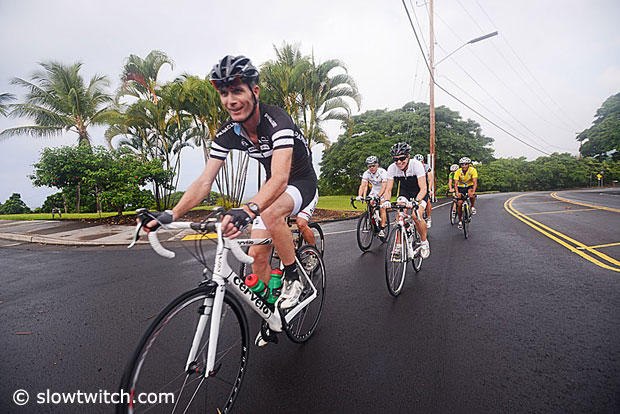
Group ride in Kona, Hawaii heading to the Kaloko climb. Picture - Tim Carlson/Slowtwitch

I've been lucky. All the way along, whether I was a runner, a triathlete, a cross-country skier or a cyclist, I have always had the opportunity to regularly train with people better than me. . . in some cases a lot better than me! I believe that to a large degree, this has been an important part of the, "success" that I experienced along the way, no matter what I was doing in endurance sports.

It's not all absolutely worked out that way. It took me a number of years to figure out the dosing on this. For example, when I was a runner, of some note back in my teens and early 20's, I ran with these better people almost every day. Every workout, particularly hard intervals sessions and tempo runs was like a race! In fact, I probably had some of my best "races" in workouts! Even easy days, were hard!

I recall one session of 7 x 800m intervals on the track that was a 5000m race simulation workout that, was run at a pace way over my head, with a rest session much too short for me to recover. This was a group of  eight or nine strong runners that included, Provincial and National team champions, and team members. Never-the-less, I grimly hung in there, and when my turn to lead, in the lead rotation, came up on the 2nd last interval, I was able to hold the lead all the way, and nail the pace and the 800m split to the second . . . nearly killing myself in doing so. I some how managed to survive the absolute last 800m, but was well off-the-back of  the group in the final 100m. I never duplicated that, "performance" in an actual 5000m race!

As I moved onto triathlon, the situation was the same - regularly training with the absolute best people around in my area and nationally. Ditto with nordic skiing - which became my winter "off-season", from triathlon, but also involved some mammoth ski training, again, often with really good skiers. However, now I was starting to understand better my own needs for periodization - when to load it up and when to back off. When to go hard and long with the group, or when to go easy and do my own thing.

However, it was not just the red-line on the rivet training that, is impactful when you train with really good people, often it's the little things you notice about a world class athlete: How they move? What they wear? What they look at? What's important to them . . and so on.

I have mentioned here before about riding with former Pro Cyclist Alex Steida back in the early 90's in Vancouver. Sure, the riding with Steida was fast, but when you sat on his wheel or road beside him in the group, it was, how at ease he looked no matter what we were doing, that I always noticed. The reach back to grab an energy bar out of the rear pocket of his cycling jersey. Having a drink of water from a water bottle - it all had this extraordinary economy to it all. Grace and calm under pressure!

I recall a run at Christmas time one year in Victioria, BC, with Peter Reid who had just won the first of his three Ironman World Championships two months before, and a young Simon Whitfield, who was just over a year away from winning the first ever Olympic Gold Medal in Triathlon at the 2000 Sydney Olympic Games. The pace for the 16 K run was decent, but not overly fast - in fact Reid had advised us that we had to run "slow". The conversation, was non-stop, and, almost never about training or triathlon! Light and easy. I learned a lot from that run.

Today, my best days as an endurance athlete are far behind me. I don't race much, if at all. Cycling is my thing now. Again, I am lucky in that when I do go out for a group ride, with our local cycling club, the group is peppered with some impressive talent with some of the best Master's cyclists in the province, and in all of Canada! Just hanging in with these guys, and not getting dropped is an achievement and an honor!

Some seek the solitude of solo training. I do too. This quiet time away from everything, I have always found helpful - in many different ways. The trick as I mentioned, is balance. When I was a teenager, running, it was unbalanced towards the side of too much, group training at too high a level. Later on, I realized, how to better balance it all, to get full advantage of the opportunities that training with other better athletes would give me.

The higher level message and take away here is that there is a lot to be gained and learned from training with people who are better than you. I know that I have benefited from it, greatly over the years. Probably did a bit too much of it when I was runner, and had a more balanced approach with it as I got older. But, perhaps I would not have run as well as I did, or developed the massive base of fitness that all that running did for me had I not run like that for 5 - 6 years. Hard to know.

Used properly, group training with better athletes can be highly effective in bringing out the best in you. Don't shy away from it.

Do you train with better people?

If you like what you see here, please feel free to share this blog with your preferred sharing app from the buttons below:

Monday, December 6, 2010

Training Naked!

Back then they really trained naked!

Do you train naked?


Not talking about training in the nude - sans clothes, although I am sure there are some who do that to! Make sure you use sunscreen! What I am talking about here, is training without all the modern training and monitoring tools that almost everyone seems to be using these days - heart rate monitors, power-meters, GPS units and so on. Some also call this training blind.

I came of age as an endurance athlete back when none of these tools where around. Training tended to revolve around pace and time. These were the guide-lines and benchmarks that we used. Race-results were how we measured progress. The stop-watch and the results sheet don't lie! If we were going out for a 2 hour ride, we noted the fact that we had been out about an hour with our Timex watch, and it was time to turn for home. Simple! That was as about as advanced as we got.

I recall winning a nice Polar heart-rate monitor (HRM) a number of years ago, when I won a 5K running road race. I was interested to see what it was like training with it. Having taken Human Physiology at university and at that point having trained for over 10 years at a moderate level, I was familiar with the different zones and the importance of them in training. After doing some testing with the new HRM and finding out my maximum heart-rate through some field testing, I was able to establish what my zones were and what my heart rate ranges for each zone.

Remarkably, all my key training paces for both bike and run, matched up almost exactly with the key heart rate zones established for training. I had been using the various zones and knowing exactly what they were, by knowing how my body felt at those efforts and levels of intensity, and what the effort felt like, with the only outside input being a wrist-watch!

In a previous blog I talked about running frequency - runs/week - and how this was a great way to establish a solid base of running fitness. You could easily sub-in cycling or swimming to that frequency program as well. In that Blog I suggested that people, not worry too much about how they are running, the pace, the time, the heart-rate, and just run. Run so that you will be able to repeat that run the next day, and the day after that, and the . . . and so on. If you do this enough, in any sport, with a bit of trial and error you will find that edge, of where you can push it a little bit, but not go over. This is key - to find that true edge of your aerobic and endurance fitness and surf along it for little bits of time, and start to extend the time spent at the edge, based on feel. Why is this important? Because, this is what you are doing when you are racing - finding that edge, and then trying to maintain the maximum effort/pace for the distance that you are racing.

To newer athletes who have started up training exclusively with HRM's and power-meters on the bike and carefully scripted spread-sheet training programs based on numbers, limits and zones, this may seem absurd and a bit scary, but if you start training naked and based on feel, you will start to develop a very tuned-in sense, of how you are breathing, your stride or pedal rate, your turnover in swimming, how your legs and muscles feel, at that level of effort. You'll know, and that's a really good thing. The off-season, which is now for many triathletes, runners and cyclists, is a great time of year to try this. Just, run, or ride or swim. Go easy. Go hard. Find the edge. Note how you feel and what's going on with your body.

Do you train naked?

If you like what you see here, please feel free to share this blog with your preferred sharing app on the buttons below.

Tuesday, November 9, 2010

Running Frequency


When we talk about running frequency there are two kinds of running frequency. The first is your stride rate, the second is the number of days each week that you run. Both are important, but I am going to be talking about the latter here.

For many the off-season is here and it's time to shake things up a bit. They say the off season is the best time to work on your weaknesses and from what I have seen in triathlon of late, no one is running terribly fast. This represents a great opportunity for those who are serious about improving their running.

There are a whole bunch of ways to really improve your running and if you ask 20 athletes and coaches you will get a broad range of ideas about how to do this. Increasing the number of days a week that you run is really straight-forward - increase the number of days/week that you run to 6 or 7 days and do this for a minimum one month. Now this is where many triathletes start to loose the trail. "Run 7 days a week", they say. "You are kidding"! However, the tendency here is to over-think this. If they are like most triathletes that have been given a program that has a nice balanced approach to swim/bike/run. That's good to get going, but it will only take them so far in each of the individual sports - soon they will plateau. Furthermore, each of their run workouts is perhaps a little bit longer and harder, because they are only running, perhaps two or three times a week. So, what they need to do first is figure out what is a typical run week for them in miles/Kilometers, and then divide that number by 6 - 7. Start there. Start running that distance, every day the first week and just run. See how you feel.

The next question is what about the bike and swim? To maintain swim and bike fitness, try and squeeze in 1 - 2 shorter (30 - 45 mins.) higher intensity swims/bikes each week, but keep the focus on the run.

For the more advanced - make it a goal to run a minimum of 20 minutes every day. That would be your shortest run, and your longest would be about an hour. Again - don't over-think it. Just run. If you feel like picking it up a bit - go ahead and do so. However, this is key - whatever you do, needs to be repeatable the next day. No single run should leave you so wiped out that you cannot run the next day. You see, great fitness and a really deep base of fitness is not built around individual or special workouts, it's built around day after day, and week after week of putting in the time at a modest level of effort. Endurance training is really not that complicated. It's about putting the work in and getting it done every day over a long period of time.

Be careful to monitor how you feel. If you feel tired at the start of a run, that's OK - often as you get into the run the fatigue goes away. However if it stays, make that a 20 minute and done day! Also note aches and pains - note the transient pains that tend to come and go as compared to the permanent ones that will not go away. If it is the latter, stop the run-every-day-routine. Do not force yourself through this, if you have more serious injuries.

After a week or two of running every day and if you feel good, start increasing the total weekly volume by 10 - 15 percent. Don't add all the distance onto one day - spread it across the week. There is a tendency to worry about, heart rates, and zones, and tempo and intervals and all that other stuff - again, just run. If you feel tired. Take it easy. If you feel like picking it up for a bit, do it, and keep it relaxed and flowing. But know that you have to run again tomorrow!

Keep this up for a month, but ideally try it for two months. The gains are often significant in terms of fitness and efficiency. Schedule a bit of a taper and then find a 5K or 10k running race. Many are shocked and surprised, to set significant new personal best times, after this focused block of what many would consider unstructured training - again, it's not the individual workouts, it's the cumulative effect of all of the running over time.

Final note. This also works for swimming and cycling. A focused block of doing almost all one sport, for period of time, in the off season, is never a bad thing.

Hope this helps.

Like what you see? Please feel free to share and pass along via Twitter, Facebook or your sharing tool of choice by clicking the links below.

Monday, December 1, 2008

Run and Done


The truly interesting thing about the run leg in triathlons is that regardless of the format of the race or the length of the race, many big, highly competitive triathlon races are always sorted out on the run. It's been this way since the early days of the sport. The run leg has always had a high importance, if for no other reason than, that it's last!

What I have noticed over the past few years is that in general, run performance in triathlon races is dropping or at the least is not getting any faster. This to me represents a great opportunity for the triathlete who is serious about increasing their place performance - in particular those looking to place on the podium in their age-group or score a qualifying spot for the IM World Championships or the 70.3 Championships. Run performance in triathlon is a complicated thing. However, the bottom line is that, however you improve your run performance, it's almost guaranteed that if you run faster, you will place higher and finish faster!

The three biggest influencers on race day, run performance are, bike fitness, appropriate bike pacing and then overall run fitness. I am going to address this last point here. Many people start out in triathlon and get a nice balanced training program from their coach or work out a nice weekly routine that works for them. Typically, this involves 2 - 3 run workouts per week. This is a great way to get things rolling and many athletes will go a long way with this sort of a program. However, often it's the run leg that is letting them down. Assuming, decent bike fitness, and appropriate race day pacing - it very well may be, overall run fitness that is holding them back.

What to do? For athletes like this, in particular those with a chronic weak run leg, those in the sport for less than 3 years, an off-season run focus can really help ramp up the fun fitness and tri-race, run leg performance. The good news is that it's a remarkably straight-forward program. The bad news is that . . . . . well, their really is no bad news other than it's going to take a few months to get some solid returns.

How to do this? Start thinking like a runner. Runners only run! That should be a clue as to where I am going here. The first thing you need to do is start running more days/week. If only running 2 or 3 days, you need to start working up 5 to 6 or even 7 days/week of running. Set a minimum, that you will call a "run" - 20 minutes is a good minimum. If you are having motivation problems, seek out friends or a running club, that will help get you out the door to get this done. There is a group over on the Slowtwitch forum working on 100 run days in a row! Once you have become comfortable running 5 - 7 days/week, then start to increase overall weekly volume - 10% week has become the standard and is a good safe target to shoot for.

Too many, worry too much about what these run workouts should be like - what pace, what heart rate, how long, how hard . . etc . A rule of thumb is that you should be not so stiff and sore so that you can't repeat that run workout the next day. A little bit of stiffness is OK. If it goes away in the first 5 - 6 minutes of running - that is about right. Just get out and run - some days you'll run faster, other days will be slower. It's not the day to day running that's important here, nor what you do week to week - it's putting together a block of time ( I would suggest a minimum of 3 months) where running is your focus. It's the total amount of running over a longer period of time that is key.

In a previous post, I talked a bit about triathletes running marathons. My suggestion would be to resist the temptation to do this - do the training for the marathon, but don't race the marathon! If you have a burning desire to do some running races, the better distances to race at would be 5K or 10K. This will allow you to run hard/fast and then allow you to get back to your run focus quickly with minimal down time.

Now, some are likly wondering what to do about swimming and cycling during this time. After all, this is the sport of triathlon we are talking about. A remarkable amount of fitness can be maintained over a long period of time with 1 or 2 very focused swim or bike workouts each week. Make them really count! For many that have to deal with a real winter( cold weather and snow etc . .), this is the perfect time of the year to do this as cycling time is going to be compromised anyway.

This is very general advice, but I almost gaurantee you, that if you do this for a minium of 3 months, and then after you get back to a more balanced three sport training program, for a period of time, that your run leg performance and indeed your overall triathlon performance will have been improved significantly.

The picture above is of my wife Paolina Allan, when she finished 2nd at Ironman Canada a few years ago. She left T2 over 20 minutes down on the lead and in 7th place. She was able to run her way all the way to second place and within 3 minutes of winning the whole race!It was a focused block of running done earlier that year that had lifted her triathlon running to a much higher level.

Best wishes. Let me know how it goes.