Showing posts with label Cycling. Show all posts

Wednesday, March 21, 2018

It's All About The Base

Climbing Kaloko in Kona, HI. Picture - Paolina Allan


Ounce again, I'm putting the 30-Year-Base to the test. If you have been involved in an endurance sport (running, cycling or triathlon) for less than 5 years, with all due respect, skip right to the end of this post for the final good news.

It's at times like this that I'm thankful that I've been doing what I have for the last 30 plus years. You see, there is a huge advantage to having a massive base of aerobic fitness that you can tap into. You can do things and get away with things that the newer athlete can't.

In a few weeks we are off to Cuba again for some cycling with some pretty serious road cyclists. I'm really looking forward to it, and again, my goal is the same - don't get dropped!

Because of the big base of fitness that I have, over a relatively short period of time, I can elevate my regular fitness to a higher level reasonably "quickly". It's not easy, and it does not come without some genuine, hard and concentrated work, but I always surprise myself, how quickly the fitness does ramp up. I've been using several different sessions on the indoor trainer, coupled with steady state riding on the rollers on the "off-days". I dug into some old training logs, and also read up on "Sweet-Spot" intervals. As a classic "pursuit-style" rider my whole life, these are the kinds of sessions that I both "enjoy", if that's the right word,  have a high impact, and ramp up my fitness quickly. 

The other two sessions I've been doing are NOT so enjoyable (to be honest they are ugly, brutal and painful) - but are also high-impact: T-Max sets, as well as one minute All-Out bursts with almost full recovery - I've always been the, world's worst sprinter on the bike, but these sprint sessions forces me to activate and work this range and the five fast-witch muscle cells I have in my whole body!! Both these sessions have me on the trainer for 60 minutes or less. A painful, 60 minutes - but a productive, 60 minutes!

And it's all coming around - a month in and with just two weeks to go, I can feel the legs and the lungs coming around. I'm looking forward to the trip to Cuba, and fingers-crossed, not getting dropped from the main group.

The good story to end this with and for the newbies just joining back in now, THIS is one of the key up-sides and advantages to hanging in there for the long-haul with endurance sports. Once that serious, long-term aerobic base is established (roughly 5 years or more), you can whip yourself back into some pretty decent form over a relatively short period of time. 

The BIG base is helpful in other ways. When you have some down-time either by choice (vacation, taking a break etc , .) or by force (injury, sickness), the loss of fitness tends to be more minimized the bigger your overall fitness and aerobic base is, and the quicker you will return to good to great form!


Saturday, February 24, 2018

The Work Is Finding The Work

Onsite at a Multisport Canada Triathlon Race. Photo - Mike Cheliak

I'm extraordinarily lucky - the Work of Race/Event Announcing and Sports Commentary, does not feel like work. An entire day - that starts in the dark at 6am, at a big running, cycling or triathlon event and ends late in the afternoon, when the last finisher is across the finish line, and the awards all done - goes by VERY fast for me. I LOVE doing this. The work is finding the work!

I spoke recently with someone in the music business, and they said that it's the same for many bands and musicians. Not every band and musician is U2 or Beyonce! When those lesser known bands/musicians are performing, most of the time it does not feel like work - they are very passionate about their music and their performance - that's why they are so good. They could keep going on and on! The work is finding the work!

Thank goodness for my back-ground and experience in Sales. My phone rarely rings for Race/Event Announcing or Commentary work. I have to make it ring, and treat finding new work, as a classic B2B exercise. That means lot's of phone calls, cold-calls, email reach-outs, and networking/connecting via social media - I'm a big fan of both LinkedIn and Twitter for this.

There are lots of dead-ends, no-responses, "No's" and "No thank you's" - occasionally, you get a few "Yes's". It sounds pretty bleak, but that is B2B Sales work. You just keep going! The work is finding the work!

My "Off-Season" of working to find work has been reasonably successful for this year (2018), I've re-booked back in with many existing clients ( a hearty and grateful, Thank You), and have found a number of new clients who I will be working at this year ( a BIG Thank you to all of you).

In addition to the Live On-Site Race/Event Announcing my Live Stream Commentary work continues to grow - I'm REALLY enjoying doing this.

All-in, I already have over 33 gigs booked in for the year and have already started the year with a series of Indoor Track and Field Meets doing Live Stream Commentary.

With apologies for the pitch - remember, the work is finding the work(!), but if you are in need of a Race/Event Announcer or Commentator, please don't hesitate to contact me at stevefleck61@gmail.com or 416.888.7324

See you at a race or event soon!


Wednesday, March 9, 2016

My 2016 Race/Event Announcing Schedule

Bringing in the last finisher at the Toronto Island Triathlon! Photo - My Sports Shooter


I have a busy schedule of race/events that I will be working at this year as Race/Event Announcer. Below you will find my schedule.

I love doing this. It's a great privilege and honor to be involved in so many amazing race/events over the course of a year.

Safe and happy training to you all. I look forward to seeing you on many start lines and being a small part of your dreams and ambitions at the finish line.

Let's DO this!

My 2016 Race & Event Announcing Schedule is as Follows:


Feb 19 - 21 Athletics Canada National Indoor Championships for ACTV & RunnerSpace http://www.athleticscanada.tv/

Mar 4/5 - Athletics Ontario, Indoor Track Championships - http://athleticsontario.ca/

April 3 - Toronto Triathlon Festival VIP Event - http://www.torontotriathlonfestival.com/

Apr 24 - Paris-to-Ancaster http://www.parisancaster.com/

May 1 - Goodlife Toronto Marathon http://www.torontomarathon.com/

May 8 - Ottawa SportingLife 10K http://www.sportinglife10k.ca/Ottawa/

May 15 - Campagnolo Gran Fondo New York https://gfny.com/

May 27 & 29 - Grey County Road Race & ITT http://greycountyroadrace.com/

May 28 Spin-The-Lakes Tour - http://www.bikemuskoka.ca/

June 4 - Destination Races Leesburg, VA Wine 1/2 Marathon http://destinationraces.com/runvirginia/

June 5 -  Becel Ride for Heart http://www.heartandstroke.com/

June 10 - Cambridge Mile http://www.runforlife.ca/classic-mile/

June 11-  Recharge with Milk Woodstock Triathlon http://www.multisportcanada.com/woodstock/

June 22  - Halifax NTL Meet for ACTV & RunnerSpace http://www.athleticscanada.tv/

June 24 - Guelph Inferno Road Mile http://www.speedriverinferno.com/

June 25/26 - Recharge with Milk Welland Triathlon http://www.multisportcanada.com/welland/

June 25(night) - Guelph NTL Meet for ACTV & RunnerSpace http://www.athleticscanada.tv/

July 9 - Recharge with Milk Belwood Triathlon http://www.multisportcanada.com/belwood/

July 10 - Toronto Triathlon Festival http://www.torontotriathlonfestival.com/

July 16/17 -  Recharge with Milk Gravenhurst Triathlon http://www.multisportcanada.com/gravenhurst/

July 24 - TriFun Kids Triathlon http://www.trifunkids.com/

July 31 - Recharge with Milk Kingston Triathlon http://www.multisportcanada.com/kingston/

Aug 6/7 - Recharge with Milk Bracebridge Triathlon http://www.multisportcanada.com/bracebridge/

Aug 20/21 - Recharge with Milk Toronto Island Triathlon http://www.multisportcanada.com/torontoisland/

Aug 27/28 - Recharge with Milk Wasaga Beach Triathlon http://www.multisportcanada.com/wasagabeach/

Sept 1 - 5  Tour of Alberta - http://tourofalberta.ca/

Sept 10/11 - Recharge with Milk Georgina Triathlon http://www.multisportcanada.com/georgina/

Sept 16/17 - Centurion Canada http://www.multisportcanada.com/georgina/

Sept 18 - Barrelman Triathlon http://niagarafallstriathlon.com/

Sept 24/25 - The Canadian Track Cycling Championships for Cycling Canada - http://www.cyclingcanada.ca/

Sept 29 - Oct 1 Milton International Classic for Cycling Canada - http://www.cyclingcanada.ca/

Oct 2 - Cycle For St Joes http://www.foundation.stjoe.on.ca/

Oct 17 - Scotiabank Toronto Waterfront Marathon for 680 News/Traffic http://www.torontowaterfrontmarathon.com/en/index.htm

Oct 29 - CXTO  - http://www.cxto.ca/

Nov 5 - OFSAA XC for ACTV & RunnerSpace http://www.athleticscanada.tv/

Nov 28 - Canadian Cross-Country Championships for ACTV & RunnerSpace http://www.athleticscanada.tv/

If you are looking for a Race/Event Announcer to add an entertaining, and engaging presence to your race/event, and take it to the next level, please contact me - stevefleck61@gmail.com or 416.888.7324

Monday, August 17, 2015

It's All About The Rubber!


For now - on a good road!


Life's to short to ride on lousy rubber!

I've never understood this - people spend thousands on bikes and then go cheap on the one part of the bike that connects them to the ground - their tires! Not sure why that is. This small contact patch, your front and back tires have with the road, is vitally important to the performance and enjoyment of your riding.

Many are paranoid about punctures, and this over-rules EVERYTHING when it comes to tire choice. It is worth being worried about, but not to the extent that many cyclists and triathletes concern themselves with. I've found the best clincher tires, installed properly to actually be remarkably durable! My wife, top coach and elite level road racer Paolina Allan and myself, ride a considerable number of kilometers in a given year of riding. On average, we get 2 - 3 flat tires between the two of us each year. That's it!

Our current tire of choice is the Continental 4000S II tires. We've had these tires on most of our wheel-sets for several years now. We ride on a combination of good roads, bad roads, really bad roads, and even stretches of gravel roads a couple of times a month. We don't baby these tires in any way . . . and that's the flat rate: 2 - 3 on-the-road flats/year. Last year I think there was only 1 between the two of us!

Over the course of many years of cycling, we've ridden the best tires from, Vittoria and Michelin as well, and the results are similar.

I'm not a numbers and tech-guy but those that know far more about this than I do tell me that, the Continental 4000S II's offer the best all around combination of performance, and reasonable durability of all of the top tires these days. I like the feel of them, and on the durability side, our own on-the-road experience speaks for itself. Also, they go on/off all the rims/wheels that we need to get them on/off easily - particularly after they have been on a rim for a bit and inflated at the proper pressure.

I can't emphasis this enough - proper installation of tires, from the removal of old tires and a flat tube through to the installation of a new tube and tires is VERY important. It's not that hard, and it is something you very well may need to do on the side of the road on a training ride or a race! No one should need to make, "the call of shame", nor need to abandon a race because of a flat tire! It's a minor inconvenience! If you know what you are doing, it's a 2 - 3 minute exercise and you are back rolling again in no time. There are numerous online resources for this. Commit to being able to do it yourself! Many get flat, after flat, after flat . . . these are almost always installation issues.

Which brings me to my final point about rubber and tires - many over inflate. Triathletes are notorious for this. It will vary from tire size to tire size, and rim shape ( the new wider rims vs standard rims), and rider weight. But generally speaking, the proper psi, is less than you think - which will render a more comfortable, smoother and ultimately faster ride. Check with your tire mfg - most have a chart on their web sites.

As always - Your Mileage May Vary(YMMV)


If you like what you see here, please feel free to share this blog with your preferred sharing app from the buttons below: 

Wednesday, November 19, 2014

The Challenges of Cycling in York Region


*Why is it that only a few roads in York Region get this extra strip of pavement to the right?


An event called the York Region Bike Summit was/is going on today. I found out about this too late to attend.

I lieu of of attending, I thought I might sum up  a few anecdotes/observations/questions, from a regular cyclist who's lived in the heart of York Region, in Aurora for 14 years.

They have been resurfacing many of the secondary roads in the region, more out in the country-side, recently which is great.* Why is it when they do this, do they not add that extra meter of pavement on the other side of the white right line to all the roads? Safer for cyclists and for motorists!

I see that bike lanes do get added intermittently in some of the municipalities. Newmarket did add a bike lane to Bathurst on their section of Bathhurst when the road was refurbished recently, but when Aurora refurbished Bathurst on their stretch, extended to the south . . no bike lane! Why?

Aurora just added a bike lane on Bloomington Side Road between, Bayview and Yonge street. It's a great addition. Nice to see. Unfortunately this bike lane goes from nowhere, to . . . nowhere! I've cycled along there maybe 15 times since the spring. I've never seen another cyclist on it!

Some form of education, perhaps starting right at Drivers Education, needs to go on regarding cyclists. It's extraordinary the numbers of drivers I encounter on roads in York Region who tell me flat out, and with a straight face that, "Bikes are not allowed on the road!"

The sprawl has led to many services, and retail, being too far to walk for many (although it's not that far for some!), but a great deal of services and retail, is within an easy bike ride of thousands of homes in York region! I cycled over to a new shopping mall near me a few years ago that was less than 1km from my house. There was no proper place to lock up my bike. I polity asked, the store manger why this was the case. Her response: "We did not even think of that!"

When I walk around my neighborhood, and I peer into the garages of neighbors, I see that more than a few houses do have bicycles of some form in those garages. This is good news.Yet, I never see these people out riding their bikes . . . ever! Why?

The sprawl goes on and on. When they sell these ever sprawling sub-divisions in York Region, the collateral marketing material used by the developers (brochures, billboards,  construction hoarding etc . . .) seems to frequently picture people walking, and . . riding bicycles, with tag lines such as, "Live close to nature . . . ". Yet, in an extension of the last paragraph, it's rare to actually see people out walking or riding anywhere in York region!

My sense is that the forces at work here are massively cultural/societal and will be really hard to change. When people are asked why they don't cycle more they'll come up with all manner of reasons and excuses - safety, weather, distance . . etc. My gut feeling, and I hate to say this, that as a culture and a society, particularly in heavily suburban areas of North America, such as York Region, we are becoming more lethargic and lazy! Go ahead pile-on. However, the ultimate evidence and acid test of this . . . our ever expanding waist lines!

If you like what you see here, please feel free to share this blog with your preferred sharing app from the buttons below: 

Wednesday, August 27, 2014

Finish Lines

K-Town Tri Finish Line. Photo - Bob Hatcher

The finish line of a an endurance sports event be it running, triathlon or cycling is a special place. It's the goal. The destination. The place that many want to get to. It's when the clock stops. It's a place of high emotion. It's where you want to be!

I am lucky in my work as a Race & Event Announcer that I get to stand there at many finish lines of many races, in many different places and see it all! The pain. The joy. The exuberance. The sportsmanship. The battles. The camaraderie. The friendship. The solo runs across the line and the photo finishes. I get to witness it all up close and personal. It's the best part of the job! Finish lines are FUN!

In a way, the finish line is a metaphor for life. We set the goal. We commit. We work.  We organize. We train. We organize. We start. We finish! Across the finish line family, friends, loved ones, high fives and handshakes await. We then get to hopefully bask in the accomplishment and fulfillment of it all!

A few weeks ago I was back in Kingston, Ontario at the historic K-Town Triathlon. This is one of the oldest triathlons in North America.  It was the first race that I remember coming to in the mid 1980's, that had large-city main-street run in, and a big marquee at the finish. At the time it was the longest race I had ever done (2K/55k/15K). Getting across that finish-line really meant something to me at the time.

Working the finish line microphone on that morning in Kingston was a real treat for me - to relive my memories from a long time ago, but also to be there, and be part of new memories and experiences for many others.

What do race finish lines mean to you?

If you like what you see here, please feel free to share this blog with your preferred sharing app from the buttons below: 

Thursday, August 21, 2014

The Road Less Taken


When I first got into cycling via the sport of triathlon, one of my favorite places to train and ride was my family's cottage in the Muskoka area, about two hours north of Toronto. To get to the paved roads, I had to ride 5 - 10km over gravel roads at the start of each ride, and then also at the end of every ride. Thus I became used to and adept at riding on the gravel and dirt early on.

Whenever I am out riding my road bike and the road turns to gravel, I typically just keep going. For me it's always been part of the adventure. And if you know what you are doing, riding on gravel is not as challenging as it first seems. I wrote a primer on rough road, and gravel road riding a few years ago. You can see it here.

In and around cities and even on further out into the country, there has been a movement over the past 20 years to pave many roads, that were at one time gravel. However, if you keep heading on out from suburban areas, eventually, some/many roads turn permanently to gravel!

Here's perhaps the best thing about riding on gravel roads - few if any cars! On a recent two hour ride on gravel roads, I encountered one vehicle. They stopped and wanted to know if I was OK or lost! That never happens on paved roads these days! With cyclist/motorists confrontations at an all-time high and growing - this very fact alone, makes gravel road riding appealing. Life does seem to be more laid back on gravel!

As noted above, a road bike, can handle the gravel very well - you may need to go slower and pick your way through some of the rougher spots, but a ride on a gravel road is not a time trial. As interest has built, some bike manufacturers have started to make gravel road specific bikes. Overkill, you may say . . . read on!

Raleigh Canada was good enough to send me one of their Tamland series bikes for a test ride. For several weeks a put the Tamland I through it's paces, including the 2 hour ride noted above. Compared to my normal road ride - the Tamland I is much better choice for the gravel. The longer wheel base, lowered bottom bracket, and relaxed geometry, all add up to a much more stable and confident feel on gravel. You can really roll along at speed.

Other features of the bike - the fat 700 X 40 Clement gravel specific tires, the Shimano 105 drive-train, and the TRP Spyre mechanical disc brakes, allow you to really start to roll with precision and control after you get used to being on the gravel.

Now, this is no light-weight, but the Reynolds 651 chromoly steel frame, is extraordinarily rugged, and the mass, actually adds to the confidence when you are bombing along in loose gravel and over washboard! You feel . . well . . grounded!

When you have a bike like this, the mind really starts to wander . . . where could I use this? Where could I ride it? Obviously, it was designed for the gravel - but the bike would also be an awesome urban commutator - with ample room for fenders, plus the benefit of being able to handle the terrible pavement that now seems to be common place in many older cities.  It would also make a great touring bike - and with a change to lighter/narrower tires and wheels it could also be a great machine for the odd century ride or Gran Fondo.

The Tamland could also be pressed, again with different tires, into use in cyclo-cross racing, but the geometry is a bit off of what a true CX bike is all about. That being said, light trail use, even in the mud, would be well within the bikes capabilities.

For a dedicated road rider, who's not interested in a full blown mountain-bike, or the triathlete who wants a second non-TT bike, something like the Tamland, makes an awesome choice. You really can't go wrong!

If you like what you see here, please feel free to share this blog with your preferred sharing app from the buttons below: 

Friday, June 20, 2014

The Key Contact Point on a Bike - Part 2. Time For New Shoes!


I have vivid memories of my first real cycling shoes. They were purchased in the early 80's - black, all leather, lace-up Detto shoes. It made me feel like a real cyclist. They had holes all over them to help keep your feet cool. I don't recall the coolness, but I do recall having the Dettos shined up, by a street-shoe-shiner, in Baja Mexico when I was down there to do the Tecate-Ensenada bike ride back then. The shine-job left permanent block polk-a-dots on my socks!

I was having a bit of a flash-back to the Detto's when I opened the box of my new Giro Empire ACC shoes. Like a few other things in cycling - everything old is new again, and the Empires don't disappoint on this front - they are lace-up shoes, for one, and they have these, not really holes in the uppers, but micro perforations to aid breath-ability!

The Empire shoe model started as a collaborative, one-off project between Giro and BMC Pro Taylor Phinney. Phinney came to road cycling from the track, and some of the shoe manufacturers still made lace-up shoes for track cyclists. The project grew from there with the Empire being introduced to the impressive Giro shoe line 2 years ago. It's started to catch on!

Most modern cycling shoes have given up on laces, and most commercially available shoes and the most popular shoes, be they for road cyclists or triathletes*, will use Velcro closure straps, ratcheting systems, or now becoming very popular, Boa closure mechanisms - or a combination of two of these systems.

*FWIW - I note that the Empire ACC is not a shoe for triathletes!! Unless you like longer transitions times.

Laces, may seem old-school, and a bit of step back-wards, but, you can really micro-dial in the fit across the top of the shoe and around your foot. Of course, the one major draw-back of this, compered to the other, now, more conventional mechanisms is an inability to adjust on the fly with the Empires.  You need to dial in the fit and the tension before you start riding and can only change ounce off the bike. I was able to sort this out after the first few rides! One tip I found helpful - put the shoes on early in the getting-ready-for-the-ride process. Then if you have under/over-tightened, you can change before getting on the bike. In other words, don't wait to put the shoes on last, and jump on the bike!

I'm very particular about cycling shoe fit and am cognizant of the fact that cycling shoe fit is very individual. However, I will say that the Giro Empire with it's completely seam-less upper fit my somewhat normal, average width feet, very nicely. I did have to size down a half size - I've been consistently a 44 in several other brands over the last few years - 39.5 was the magic number for the Empires.

While the Emprires may seem a throw-back to days of old and the Detto's, other than the laces the Empires are  cutting edge in cycling shoes. They are feathery light! The Easton EC90 sole is one of the stiffest and thinnest around. The upper is made from EvoFiber utilizing silver embedded anti-microbial X-Static fibers in the lining. The shoes also come with Giro's own SuperNatural fit-kit of an insole and 3 interchangeable arch supports. I fiddled with these, but in the end used the custom molded insoles from a previous pair of shoes - for me that yielded the best and most comfortable fit. They've even come up with a solution for, what to do with the lace ends ounce you have them tied up - you put them through an elastic hold-down strap, that's part of the tongue!

On the road and on the bike they have been outstanding. I run Look pedals and cleats (see more here) - mounting and interfacing was perfect. The sole is a bit flatter front-to-back, than my previous shoes, but after a few rides, I started to really like this, particularly when ankle-ling in the pedal stroke in a bigger gear. The inability to not be able to make adjustments on the fly, as previously noted, for me has been a non-issue. I wore them early-on (5 - 6th ride), in the 100 mile Gran Fondo New York race, and never needed to change lace tension the whole way!

Finally, they sure are conversation-starters - people want to know more about them. "What are those", people ask? And so I tell them a bit of the above story!

Thanks to Heath and the team at La Bicicletta in Toronto for help with a size exchange.

If you like what you see here, please feel free to share this blog with your preferred sharing app from the buttons below: 

Monday, April 28, 2014

The Key Contact Point on a Bike - Part 1


 The under-side and business part of the new Look Blade 2 pedals.

This is the first of a two part series on what I believe is the key contact point on the bike - the pedal-cleat-shoe interface.

Contact points with the bike, are big with me. Previously I have blogged, about handle bars and even bar tape - stressing their importance, as key contact points. While others seem to stress about frame weights and materials, aerodynamics and Crr, for true riding enjoyment, comfort, and ultimately performance, it's the contact points we have with the bike, that are key to a great ride with optimal power transfer!

As to the last point - the pedal-cleat-shoe interface is where your hard earned fitness and power is transferred to the bike, then to the road, and is driving you forward! It's more important than you think.

There's lot's of choices for pedals. Some of this will be based on individual feelings and needs. Full confession, I've been a LOOK-man since they first came out with the first clip-less pedals back in the late 80's. I've had various LOOK and LOOK compatible pedals over the years. For me they have always worked, and worked well. The designs have been reasonably simple. The pedals have been durable, and easily maintained. They have always lasted longer, than I would have thought given the abuse they get.

My LOOK Keo Carbon pedals were starting to show their age. When the pedal platform and interface point on either the pedals or the cleats start to get worn down to the point, that you are getting a bit of medial-lateral rocking it's time to change either the cleat or the pedal or both.  Closer examination, of the old Keos. showed that the platform was showing some micro-wear - that even new cleats may not have helped with.

Naturally, I first had a look, at the current LOOK line up. When the Blade came out a few years ago, It looked intriguing - but the reviews were mixed, and like many I was a bit concerned with the exposed outboard location of the actual carbon fiber blade on the pedal - the functional part of the pedal that was applying the force to keep the cleat clicked in. It appeared, one, even minor bike crash, with a laying down of the bike on the side, might render the pedal useless!

For 2014, Look completely overhauled the Blade pedals - now called the Blade 2. The carbon fiber blade was widened, and moved to the very bottom and middle of the pedal. This made the pedal more rugged and, FWIW - improved aerodynamics of the pedal itself. It's so good at this now, LOOK stopped making a truly aero Blade pedal, for the time-trialer and triathlete!

Other improvements include a substantial increase in the contact interface between the pedal and the cleat (now 17% wider) and a slight lowering of the stack-height to the pedal axle ( now 13mm). Reviews, of the original Blades were that the click-in was a bit vague, and one could hardly tell you were even clicked in. I can say, that the with the Blade 2's the click-in feel is not dissimilar to the very popular Keo line - by both feel and and a nice and noticeable "click" noise. You know you are in!

The Blade 2 comes in three set tensions ( the Keos had adjustable tension) 12nm, 16nm and 20nm. I'm riding on the 12's, and they are similar in tension to the way I was set up on my Keo's - which I would judge as moderate. I'm told that most Pro level riders, who are riding the Blade 2's are going with the 16's. The 20's? Maybe for track sprinters?

Riding impressions: Fantastic - compared to my Keos, the contact with the bike seems more firm, positive and substantial. I use the grey LOOK cleats, that have a bit of float and everything feels amazing.

The one slight negative that I have about the Blade 2, is, that the pedals do not naturally return, to that heel-down position, that the Keos, and most other similar pedal designs do. This makes getting in the pedal a bit frustrating at first, as you are always expecting the pedal to be in that position - ready for action! It's this way for two reasons - LOOK used more robust seals on the inboard bearings, than previously, so the pedals don't spin as freely when un-weighted. The bigger reason, is the weight of the pedal is now more evenly distributed throughout the pedal and not concentrated in the heel - as it is with the Keo's. So, the pedals when you click out, if they end up up-side-down, will tend to stay up-side-down, until you want to click back in. Here, a little flip with the toe is needed to spin the pedal back into the correct position, to click back in cleanly. It takes a few times before you get the hang of this.

If you are looking for new pedals, that are very light (110g - CroMo, 90g - Ti), offer an amazing contact interface with the cleat/shoe, and are aero, then the new LOOK Blade 2 is one for you to consider.

 If you like what you see here, please feel free to share this blog with your preferred sharing app from the buttons below:

Tuesday, February 18, 2014

Sick!


In my previous blog I spoke about being Walloped by Winter and what to do about it. The Winter season is also when Cold and Flu season peak. I'm not sure about you, but for me, I am typically felled by one garden-variety head-cold each winter. Seems par-for the course.

For endurance sports athletes, it presents a bit of a challenge. How do you beat the cold, and get back to normal ASAP? There is that gnawing worry about the down-time and the lost fitness.

Years ago, when I was much younger and perhaps not as wise, I used to push things and not listen to my body. I would ignore the early signs of the cold coming on - the body aches, the weakness, the head or chest congestion. Then it would hit in all it's fury - down for a few days, but then I would rush the come back, and the cold would then drag on for sometime with remnant symptoms hanging around for weeks.

Two events changed my views on getting sick in this way.

One time before my biggest triathlon race of the season, I came down with a head-cold just over a week out from the race. It was a doozy - sent me to bed for a few days. I was then wrestling with what to do in the run-up to the race. I chose to do nothing - no training at all. All tolled, when I toed the starting line, I had done no training for a full week. I did not feel that great physically, but that race ended up being one of my best races of the year! The one week sick-with-a-cold taper in full-effect! Lesson: A week of resting and recovery from a cold, does not impact your fitness.

The other event was more sinister. I came down with a really bad chest cold. It was very bad. I thought I had recovered and I jumped right back into training at a high level. I had a relapse, that morphed into full-blown pneumonia. This really knocked me out. Close to being hospitalized. Had to take 3 weeks off work. Two of which were spent at home in bed.

Follow-up x-rays and testing discovered that I had done some permanent damage to my lungs - perhaps losing as much as 25% of my absolute, lung capacity. Disturbing news for an endurance athlete. However, I was advised that the lungs can over-compensate and some of this 25% deficit could be taken back and the loss not noticeable.

Lesson here - listen to the body. Take the time to recover fully, before resuming heavy training!

In summary - when you get sick with a head or chest cold, just take the time to fully recover. Recent, studies have shown that despite what all the cold-medication companies tell you, nothing that you can take will make the cold go away any quicker. The OTC drugs, just make some of the symptoms easier to cope with. In short - rest and relaxation and letting the body fight and deal with the infection as best as it can,  is the best thing to do, and for the endurance sports athlete that means stopping training until you are 100% recovered and ready to go. When you get those early symptoms - the weakness, the body aches etc . . just shut it down and get as much rest as you can. Help your body help, itself!

On the defense front - the old fashioned way of frequently washing your hands, has been proven to be the best defense from getting sick in the first place. It's far better and more effective than many rumored methods that people talk about. Many of the more popular defense methods - over-dosing on Vitamin-C,  taking echinacea etc . . have proven to have little to no effect on cold prevention! Eat a healthy and well balanced diet, and you should have all the natural disease prevention and immunity that you'll ever get. Also, make sure you are getting enough sleep. Recent research has concluded that sleep, is the #1 recovery tool for your body.

Again - wash your hands. And if you do get sick, don't panic. Just take the down-time to rest up a recover well. Know that under normal circumstances your garden-variety head or chest cold runs it's course in a week to 10 days, and there is really not much you can do about that other than doing nothing at all!

Have you been sick this winter? How did it go?

If you like what you see here, please feel free to share this blog with your preferred sharing app from the buttons below:

Thursday, February 6, 2014

Walloped by Winter! What Are You Doing?


I saw a map this week online. It showed that  2/3 of Canada & the U.S., ie most of the North American continent, was covered in snow. I know that for almost all of Canada (save for the lower-mainland of B.C. and Vancouver Island) - that's normal. The snow-cover and deep cold has also extended much farther south in the U.S. than "normal" this winter.

We've been walloped by winter, actually. In my area, just north of  Toronto, ON, after a number of rather benign winters, it's been full-on this year with, from what I can tell,  record snow-falls and, the coldest average temperatures in over 10 years. For endurance sports athletes who for the most part train outside - runners, triathletes, and cyclists, it's been challenging to keep the training going. How have you been coping?

I've always had two views on this - you either take it inside, and shun winter as much as you can, or you embrace it, and make the most of it.

For the Shunners, the solutions, are obvious: For the triathlete - swim/cycle/run, can all be done indoors. If you are into this, and have access to the right facilities and equipment, in a perfect world, there can be minimal interruption in your training. True - the cycling and the running, on indoor trainers and treadmills can get a little tedious, but videos can be a great distraction and some of the interactive, computer driven indoor bike training set-ups are truly extraordinary! If you are just a runner or a cyclist, just plug into the above.

For the Embracers - the great outdoors can really open things up. Full disclosure - when I was training seriously for triathlon this was my approach. I was never a fan of the treadmill or the indoor bike trainer. What did I do?

First - I never stopped running outdoors. In fact, winter is when I would lay down the most overall volume of miles running. With the right apparel and attitude, you can run in just about any kind of weather, anywhere. Sure the footing, was lousy, the deep snow sometimes slowed you down, and the wind would force your pace to a crawl. Note the word "volume" back there - that was the focus . . not speed, pace or time. Just get the miles/K's in!

Second - I cross-country skied . . . a lot. Both classic and skating. Nordic skiing is the king of aerobic sports - it works more muscles in the body than any other single activity - upper body, lower body, core etc . . It all get's worked. When I had a great winter of skiing - where I put in the biggest volume of skiing and took my skiing to the highest level of performance, I noticed two things: 1) My cycling and triathlon performance the following summer was always better. 2) Despite very little cycling through Dec/Jan/Feb, come March, after just a few weeks of riding, I could ride 100K at a decent pace with very little ramp up!

Third - I did not eschew the indoor training completely. I would get in the pool maybe ounce a week, just to keep in contact with the feel of the water. I would also get on the indoor bike trainer, and would do one or two very high intensity sessions a week, lasting no more than 60 minutes. As to the latter, they say that even for the cyclist, who just rides, the time on the trainer in the winter, is better spent with a focus on higher intensity, power based riding, than slogging out long sweaty sessions on the trainer. These days, I only ride, and that's my focus: 3 - 4 very specific high quality session on the bike, and never more than an hour. Plus some cross country skiing mixed in.

As a Canadian, I've always had to put up and deal with a winter of some kind. It's part of being a Canadian, in my view - that's why I have always embraced winter. The Winter Olympics are about to begin, and I've found a great deal of truth, honesty and inspiration in the Canadian Olympic Committee official hashtag for the Canadian Olympic Team - #WeAreWinter.  For Canada and Canadians it's perfect!

Do you shun or do you embrace winter? What's your strategy to coping with this real winter we are having this year?

If you like what you see here, please feel free to share this blog with your preferred sharing app from the buttons below:


Monday, January 13, 2014

Shorter Cranks: A Case (n=1!) For Older Cyclists & Triathletes


There is a bit of a buzz these days for going to shorter cranks (crank arms) for both triathletes and cyclists. It's not for everyone, and like many things there are some misconceptions and misunderstandings of what's going on.

If you are in a great position on your bike and are having no issues, then going to shorter cranks is most likely not going to be helpful for you: Shorter Cranks does not automatically equal better/faster! If you are suffering some specific issues, relating to to your bike fit and in particular, where an opening of the hip angle will be helpful, then going to shorter cranks may be beneficial to you.

I had always ridden on 175mm cranks on every bike (road & tri bikes) that I have ridden since getting into cycling via triathlon in the early 80's. I had never given this a great deal of thought, because every, "58cm" bike I had ever owned, came with 175mm cranks on it! However, a couple of years ago, when I had just turned 50, I noticed a few things when riding the road bike:

1. I was getting increased lower back pain when riding
2. I could no longer ride in the drops of my road bike for extended periods of time
3. I had lost a bit of my jump

A swapping of kit on one of my wife Paolina Allan's bike made a set of Shimano Dura Ace 170mm cranks available to me. I looked into this a bit, and came across the findings of the 2001 Jim Martin study in several articles online (this one on the Cervelo web site), that came to the conclusion - basically, power generation is the same for a rider, using a wide range of crank lengths. I also compared notes with friend and Pro triathlete Jordan Rapp, who had just gone to shorter cranks on his set up, and noticed no difference in performance.

I started to put this together with what I knew was happening with my body - as I aged, I was becoming less flexible, and I was becoming weaker and less fit. Hey, it's inevitable! Shortening the crank arms, making the appropriate changes in the fit elsewhere (raising the saddle and bars slightly, to compensate), would open up my hip angle, and also make the circles that I pedal in slightly smaller.

The great news about the new crank and bottom-brackets, is that with the right tools, these are very easy to make changes - so, out with the 175mm cranks and in with the 170mm ones. I did this in the winter, so that the first few rides would be on the trainer. Just to check everything out.

I did notice a slight difference when I first started to ride with the 170's. However, by the end of a 45 minute ride on the trainer, I could not really tell any difference. Some informal bench-mark testing on the trainer over the next couple of weeks, backed up the research and observations previously mentioned - I noticed no difference in my "performance". Another difference I noted was that, at a given level of effort, I might need to drop down one cog to maintain the pedal RPM that I preferred. For me, not a big deal as I have always been a bit of a "spinner" with a naturally higher pedal RPM.

The real test came in the spring when I was outdoors again and going for longer rides:

A) Lower back pain was much reduced on longer rides
B) I could now ride in the drops like a used to
C) My jump in big accelerations on group rides was much better.

Conclusions: If you are an older triathlete or cyclist, (45+), and you are not feeling comfortable on your bike, and you have some other issues such as I noted, and all other things being equal, you might want to look at your crank length and consider trying shorter cranks. Even shorter than "recommended", or what just came on your bike. Note - at 6'2" (188cm) generally speaking, my recommended crank arm length would be 175 and as noted, on every bike I owned, it came with 175's. For me going shorter helped.

Hope this helps.

Are you an older cyclist/triathlete? Have you tried shorter cranks?

 If you like what you see here, please feel free to share this blog with your preferred sharing app from the buttons below:

Friday, December 13, 2013

Tying It All Together for Endurance Sports Events


 Working the Mic at the recent Monster Dash run in Toronto*. Picture - MyNextRace.com

I just finished reading digital marketing guru, Mitch Joel's new book Ctrl-Alt-Delete. It's a highly recommended read. Three big take-aways:

1. Social media, and marketing through social media is big!

2. The current buzz with brands, is wanting to speak directly to end-user customers.

3. Everything is going mobile!

Endurance sports events be they, running, cycling, triathlons, MOB's or themed runs, sit at the intersection of the above. By their very nature, these events are social - with lots of social interaction going on. I mentioned this briefly in a previous blog. However, this week I came across an info-graphic that spelled this out in more detail with some interesting data and stats.

These events are also the meeting up point for brands(sponsors), and the large amounts of numbers and data that these events are starting to generate and put together - to say nothing of the gathering of hundreds, if not thousands of people in one spot, at one time. Remarkably, few events seem to be taking full advantage of this. Some are, but more could and should do more. 

It goes without saying that the demographic attracted to most endurance sports events are plugged in to a high degree via mobile devices.

At the Running USA conference last winter, a marketing executive who works in the endurance sports space, said to me, "Consider you are at an NHL or NBA game, with 10,000 or more spectators. Think about how much marketing and promotion you have been exposed to from the time you buy your ticket, to the time you leave that game. Now compare that with the promotion and marketing that goes on an endurance sports event with similar numbers from the time you register, to the time you are finished and heading home". Many events, are not taking full advantage of the opportunities here.

It's a great opportunity to leverage the social nature of these events, the social interaction that is organic to them, the high adoption of social media of the participants, and the want for brands to talk directly to end-user customers.

An example of linking that up with mobile follows:

With my frequent work as a Race and Event Announcer*, I often see the collision of the old and the new at the events that I am working at and where the above opportunities go wanting. Often the number one question that I get asked when I am on the mic at an event is, "Hey - where are the results being posted up?". Many smaller to mid sized events still post up printed hard-copy, for participants to check their times/results - if the event is a timed event, with results. In the online, digital age, this now is passe. I'll often announce, where on the race site, that hard copy of the results are posted up, and you'll see that huddle of people surrounding the posted sheets of paper checking their results. However, if a company such as Ottawa, ON based Sportstats is timing the race and producing the results, those results now go almost instantly on-line when a person crosses the finish-line (or timing mat out on the course), to that events page on the Sportstats web site. If people, have a mobile phone with internet access, they can go right there, and see their own results on their own mobile device in the palm of their hand! Even more, Sportstats has a App that ties all of a persons results together that can be customized for that person. People can even "follow" a friend doing an event that Sportstats is timing around a race course. I make the announcement over the PA about this new way of accessing results to. I think it's catching on! 

See the linkage and possibilities with all of the above?

If you are an endurance sports event organizer:

- Are you taking full advantage of the social media opportunities for your event?

- Are you allowing your event sponsors to speak directly to your event participants?

- Are you tying this all together for mobile?

 If you like what you see here, please feel free to share this blog with your preferred sharing app from the buttons below:

Friday, August 16, 2013

Have Endurance Sports Events Gone Retail?

 A long line of porta-potties at a recent large running event in Toronto*

I have written in this space before recently about what's been going on in the endurance sports events business, here, and here. A lot is going on! The growth right now is impressive. If you add up all the running, triathlon, cycling, themed running events, and also the mud/obstacle races and events in North America, you are looking at a impressive double digit growth in participation numbers and an aggressive addition of new events along the way. It's hard to keep up with it all.

With all this growth has come competition - serious competition. So much so that, from what I have seen events have gone retail, where everything about an event starts to matter. Your brand. Your logo. Your date. Your route or course. How hard or easy your event is? Your registration process. How many porta-potties you have*. The enthusiasm of your volunteers. Your charity. Your timing and results company(if needed). It all starts to matter. Even stuff you have no control over, like the weather starts to matter! Get two years of lousy weather for a start-up event, and it might be done right there!

Onsite experiences on race/event day are critical. People will come, and maybe they get spoken to in a wrong tone by a volunteer, there are not enough porta-potties or registration/kit-pick-up takes forever. Just like in retail, they will silently go away, never to return, and even worse, they'll most likely tell more than a few people about it. On average, people tell 4 people about good customer experiences, but tell 13 people about bad customer experiences. And that's what RD's need to do and understand these days, beyond getting the cones in the right places, and the directional arrows on the road right - they are in the business of delivering positive participant experiences.

Even the process of race and event registration, these days almost 100% through online services, can be critical in the whole event experience. Some are complicated and unwieldy - with high abandonment rates. In other words, that person who was going to register for your event, gave-up part way through the actual registration process, for one reason or another. You got them to the door . . . but then lost them! Check out some of your sports online forums, to see what people are saying about your registration provider. You might be surprised.

It's important that events think more like businesses, albeit small ones and even non-profit ones, about their brand, and about their image, because, as noted, it's all starting to matter.

The mud & obstacle events and the themed runs, have really driven this point home. How else to explain, the extraordinary growth? Some of these event series did not even exist two years ago. Some will surpass a one million participants this year! In these situations, branding, and imaging matter greatly. There is a buzz. People want to be going to the cool event that everyone else is doing.

Now you may be thinking, "I run a triathlon or a running race. Why should I be concerned about a mud run or zombie run?" Be concerned - they are competing just like you for mind-share and commitment from reasonably young, and active people. And some of those events now really have some serious momentum, behind them and mega-buzz. You run a cool and great event, but it's just a 5K run. You have to think about everything at your event and every touch point with your event participants. How is it impacting them? Is it a quality and a positive experience, or at least matching up with their expectations?

I know the organizer of one of the largest triathlon series in North America, who stands at the finish-line of all of his events, regardless, of the weather, and personally says, "Thank you", and shakes the hand of every finisher who comes across the finish line at every event. Sounds corny, but that's the kind of thing that people remember - just like in retail they remember the good and the bad, experiences. Events need to do everything they can to make sure that everyone's experience at an event is an outstanding one. If so, just like in retail, they will be back!

Whether you like it or not, events have gone retail. What are you doing to make your event stand out? What are you doing so that each and everyone of  your race/event participants have an extraordinary experience?

If you like what you see here, please feel free to share this blog with your preferred sharing app from the buttons below:

Thursday, February 14, 2013

The Great Indoors


 Kurt Kinetic trainers all lined up at a local drop-in, indoor bike training session.


Full disclosure right up front - I've always hated indoor bike training! I have always been an outdoor-guy. No matter the weather, generally speaking I would prefer to be outdoors. However, living in the places that I have lived most of my life, that has meant dealing with white (with snow) or very wet (with rain) winters.


Back when I was far more serious about my training, my winters consisted of a lot of running and a lot of cross-country skiing. I would sprinkle-in some swimming and, a couple of indoor bike training sessions. In those days, indoor bike training was done, in solitude, in a dark, basement on a "wind-trainer" that roared like a 747 at take-off! Because, I did not really find the whole experience that enjoyable, I made it short and sweet - get-on, warm-up, knock out some really hard intervals, or a 20 min all out TT effort, warm-down, and done! Total time - one hour maxium.

With all the skiing and the steady diet of higher intensity indoor cycling efforts over the winter, I found that I could jump back on the bike in the spring ( mid to late March) and ride up-wards of 100K at a decent pace. I had not really lost all that much despite a low volume of cycling for nearly 4 months.

Today, for triathletes and road cyclists, indoor riding is all the rage. Some still do the solo-thing in their basement pain-caves and dungeons, but they can get very sophisticated these days wth all the training tools and software at the modern athletes disposal.

What seems to be even more popular are group training, with trainers either in ad hoc places (see picture above in a local church hall) or at more sophisticated and dedicated indoor training venues, built out specifically for this purpose, often with dedicated trainers by Computrainer, or other suppliers all hooked up, so that everyone can monitor wattage or other metrics and even, "race" one another!

Knowing what we know now about training with power, these indoor training sessions, away from the distractions and variables of the open road, can be very beneficial for triathletes and cyclists. Training loads and sessions can be very specific. The group environment can help as well. With a great group and a good ride leader ( A roll my wonderful wife Paolina Allan has fallen in love with - in another life she must have been a drill-Sargent!) people can be encouraged along, to levels of effort that, may not have been achievable training on their own, on the open road. In fact, it's not unheard of for some really dedicated folk to be more fit in the spring, coming off a winter of super focused indoor bike training, than later on in the year after logging more outdoor miles!

Of course, for me, personally, nothing beats the open road, and the wind in my face. However, I've learned to move my loathing of indoor training, to not quite love, but something that I will put up with for a few months, so that I can maintain, those gains from all the riding done in the great outdoors in spring/summer/fall. I've even attended a few group-sessions over the last couple of winters and, they have been fun - I can see the attraction. We are social animals. Getting together with like minded people to work hard a sweat for a couple of hours, can be "fun"!

My routine is still more or less the same as years ago. A few higher intensity sessions each week on the trainer, mixed in with some time on the rollers as well. Rarely more than an hour at a stretch. My inputs are not power or heart-rate, but some good music. That's all I need to keep me motivated. There is even a web site for that - check out Velo-Beats. Great tunes for riding indoors. The goal - as it was back then, be ready to hit the open road in the spring, ready to ride!

How's your indoor cycling going?

 If you like what you see here, please feel free to share this blog with your preferred sharing app from the buttons below:

Thursday, January 3, 2013

Train With Better People

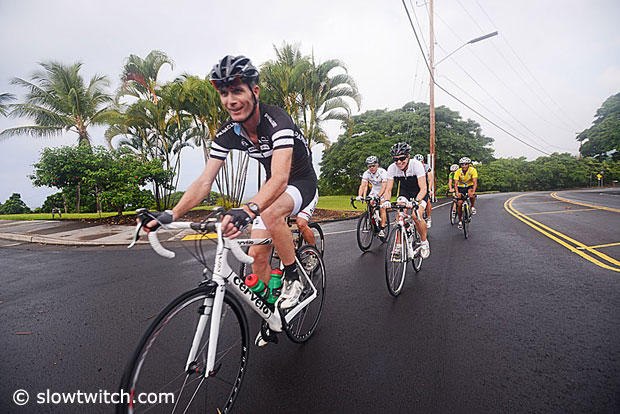
Group ride in Kona, Hawaii heading to the Kaloko climb. Picture - Tim Carlson/Slowtwitch

I've been lucky. All the way along, whether I was a runner, a triathlete, a cross-country skier or a cyclist, I have always had the opportunity to regularly train with people better than me. . . in some cases a lot better than me! I believe that to a large degree, this has been an important part of the, "success" that I experienced along the way, no matter what I was doing in endurance sports.

It's not all absolutely worked out that way. It took me a number of years to figure out the dosing on this. For example, when I was a runner, of some note back in my teens and early 20's, I ran with these better people almost every day. Every workout, particularly hard intervals sessions and tempo runs was like a race! In fact, I probably had some of my best "races" in workouts! Even easy days, were hard!

I recall one session of 7 x 800m intervals on the track that was a 5000m race simulation workout that, was run at a pace way over my head, with a rest session much too short for me to recover. This was a group of  eight or nine strong runners that included, Provincial and National team champions, and team members. Never-the-less, I grimly hung in there, and when my turn to lead, in the lead rotation, came up on the 2nd last interval, I was able to hold the lead all the way, and nail the pace and the 800m split to the second . . . nearly killing myself in doing so. I some how managed to survive the absolute last 800m, but was well off-the-back of  the group in the final 100m. I never duplicated that, "performance" in an actual 5000m race!

As I moved onto triathlon, the situation was the same - regularly training with the absolute best people around in my area and nationally. Ditto with nordic skiing - which became my winter "off-season", from triathlon, but also involved some mammoth ski training, again, often with really good skiers. However, now I was starting to understand better my own needs for periodization - when to load it up and when to back off. When to go hard and long with the group, or when to go easy and do my own thing.

However, it was not just the red-line on the rivet training that, is impactful when you train with really good people, often it's the little things you notice about a world class athlete: How they move? What they wear? What they look at? What's important to them . . and so on.

I have mentioned here before about riding with former Pro Cyclist Alex Steida back in the early 90's in Vancouver. Sure, the riding with Steida was fast, but when you sat on his wheel or road beside him in the group, it was, how at ease he looked no matter what we were doing, that I always noticed. The reach back to grab an energy bar out of the rear pocket of his cycling jersey. Having a drink of water from a water bottle - it all had this extraordinary economy to it all. Grace and calm under pressure!

I recall a run at Christmas time one year in Victioria, BC, with Peter Reid who had just won the first of his three Ironman World Championships two months before, and a young Simon Whitfield, who was just over a year away from winning the first ever Olympic Gold Medal in Triathlon at the 2000 Sydney Olympic Games. The pace for the 16 K run was decent, but not overly fast - in fact Reid had advised us that we had to run "slow". The conversation, was non-stop, and, almost never about training or triathlon! Light and easy. I learned a lot from that run.

Today, my best days as an endurance athlete are far behind me. I don't race much, if at all. Cycling is my thing now. Again, I am lucky in that when I do go out for a group ride, with our local cycling club, the group is peppered with some impressive talent with some of the best Master's cyclists in the province, and in all of Canada! Just hanging in with these guys, and not getting dropped is an achievement and an honor!

Some seek the solitude of solo training. I do too. This quiet time away from everything, I have always found helpful - in many different ways. The trick as I mentioned, is balance. When I was a teenager, running, it was unbalanced towards the side of too much, group training at too high a level. Later on, I realized, how to better balance it all, to get full advantage of the opportunities that training with other better athletes would give me.

The higher level message and take away here is that there is a lot to be gained and learned from training with people who are better than you. I know that I have benefited from it, greatly over the years. Probably did a bit too much of it when I was runner, and had a more balanced approach with it as I got older. But, perhaps I would not have run as well as I did, or developed the massive base of fitness that all that running did for me had I not run like that for 5 - 6 years. Hard to know.

Used properly, group training with better athletes can be highly effective in bringing out the best in you. Don't shy away from it.

Do you train with better people?

If you like what you see here, please feel free to share this blog with your preferred sharing app from the buttons below:

Friday, January 13, 2012

Black Socks


Are you a member of the Brotherhood of Black Sock Wearers?

The Rules seem to have mixed feelings on black Socks for cycling. However, I think they have been overly influenced by a certain cyclist from the State of Texas.

My use of black socks for cycling goes back a number of years, and way before, Big Tex started doing it. It was based more on utility and pragmatism than anything else. Back in the early 90's I was living in Vancouver, B.C. For those who know Vancouver, know that it rains a bit in Canada's Lotus Land, and you are often out riding in what locals call "Liquid Sunshine", more than you would like. There were some regular group road rides that I would attend, and I noticed that the hardest of the hard-core guys, like mountain bike ace, Bruce Spicer would wear black socks. I would always return from these gritty, wet, winter rides with my nice white cycling socks, now several shades of grey - a grey that would not wash out, no matter how many times through the washing machine, I note. So I went black! Problem solved.

I can't take full credit for it, but when Sugoi started to make cycling socks, when I was working there in the late 90's, I pushed in a planning meeting, to "Make sure you offer those socks in black". Made sense, Sugoi was a Vancouver based cycling apparel company - we knew about riding in dirty and wet conditions.

Since then, the sock business has exploded - it's a new sub specialty product category all itself these days. If you walk into a cycling or running shop you'll be faced by a wall of socks, from a variety of manufacturers, and a rainbow of colour options and designs, beyond the basic white sports sock. There are even anatomically correct options for your left and right foot . . who knew?

However, my eyes are always drawn to the black socks. My current preferred socks are the DeFeet Aireator Black High-Tops (pictured above). Simple. Basic. Black. Never get dirty. Always look the same! However, as you can see, on a quick perusal of the DeFeet website, their socks come in many different colours with all kinds of funky and cool designs. With socks these days, you can go crazy! Check out these retina wreckers from my friend Joe Foster from Sock Guy.

Now, when you see another cyclist wearing black socks, I am not sure what it is but, it's usually a veteran, someone who's been around for a few years. The kind of fellow rider that you just have to give a nod, to, to know that he/she get's it! They've been around the block a few times. They are comfortable in their own skin, and on the bike. You can be comfortable sitting on their wheel, or next to them in the group. They'll be calm and cool! And perhaps most importantly, they don't have to worry about keeping their white cycling socks, white!

Are you a member of the Brotherhood of Black Sock Wearers?

If you like what you see here, please feel free to share this blog with your preferred sharing app from the buttons below:

Thursday, December 29, 2011

Cervelo For Sale


Full disclosure - I have been a Cervelo friend, fan and owner since almost day-one, so I'll get my biases out of the way right from the get-go.

More neutral and good analysis can be found by long time industry observer and the Publisher of Slowtwitch, Dan Empfield here, as well as on a bike industry blog the Inner Ring, or a good search on Google.

The news on Christmas Eve that Cervelo was seeking a financial partnership with the Dutch company PON, with a possible option to buy, came as a surprise to many - Official News Release. However, for those in the know and for those who know the challenges of growing, and growth in this sort of business it was no real surprise, but an inevitability. Rapid growth, of the kind that Cervelo has experienced over the past 10 years comes at a high cost. While all appears good and great on the surface, great product, impressive sales, and in Cervelo's case winning races, beneath the surface the financial strains can be excessive. Everything, and everyone has a breaking point, and it reaches a point when the principals, realize it's time to move beyond the honeymoon of that post-start-up period. That's the fork in the road where Cervelo is at.

It's been a great ride, for the company that Phil White and Gerard Vroomen founded in the mid 90's as a side-bar to a master's engineering thesis project both were working on together at Montreal's McGill University. They have barely set a pedal wrong along the way. They have been true innovators in bike design and engineering. The bikes have sold extremely well. FWIW, their bikes have won just about all the biggest races in both road racing and triathlon and finally and perhaps most importantly, the Cervelo brand has an extraordinarily dedicated and enthusiastic customer base.

I agree with the other analysis of this that the new financiers, and potential owners, PON would be foolish to somehow toss away all that success.

For White and Vroomen (Note - Vroomen left the day-to-day operations of the company mid-summer, but is still involved with Board of Directors), it can be an emotional process. This is something they founded, started-up and nurtured along. Most companies reach this fork in the road at some point. For a greater insight into how this feels for founders/owners two great reads right in the sporting goods space are: "Raising the Bar" by Clif bar founder Gary Erikson, and "Let My People go Surfing", by Patagonia founder, Yvon Chouinard. In both cases after much deliberation and a few false starts and stops, both Erikson and Chouinard decide to retain the ownership of their companies. There is not a right or wrong with this - it's a highly individual decision based on the situation that the owners/founders find themselves in when they reach that fork in the road.

It sounds very cliche, but to take a company and a business to that next level, whatever that level is, often takes considerably more resources and a very different mind-set than the original owners and founders have. Despite the Erikson and Chouinard stories, walking away can be very hard for the founders, but sometimes that is what is best for the brand. That happens a lot too.

What will happen with Cervelo and PON remains to be seen. The news is still fresh. However, as I said, the folks at PON would be foolish to tamper with what on several key levels has been a highly successful bike company and brand! Cervelo is set to launch in a few weeks the next generation of it's ground-breaking aerodynamic P-series time trial bike - the P5. For the immediate future and on into next year, my guess is that it will be business-as-usual with Cervelo setting precedents and creating good industry buzz, Cervelo bikes selling briskly, and then come the racing season in both triathlon and road racing, Cervelo bikes winning many races!

How do you feel about the potential sale of Cervelo to PON?

If you like what you see here, please feel free to share this blog with your preferred sharing app from the buttons below:

Wednesday, November 30, 2011

Triathlon on a Road Bike?


On a recent trip to Arizona, I spent four days riding the new Cervelo S5 road bike (Thank you to Tribe Multisport in Scottsdale, AZ, and Cervelo for the loaner). This may be the most straight-forward, kick-ass road bike on the market. If Cervelo's numbers are right, it's as aero as many of the TT and triathlon bikes out there. Which got me thinking during the Ironman Arizona (IMAZ) race, where I spent a lot of time out on the bike course, watching triathletes ride. I noticed a micro trend: Triathletes doing the bike leg on a road bike, set up as a road bike, with no aero bars.

The other thing I saw was something that I have been seeing for a while now: Many triathletes riding state-of-the-art fully aero triathlon specific bikes, but riding a lot of the bike leg sitting up-right, hands on the base bar.

If you put the two groups together - road bike riders, and up-right tri-bike riders, it might have been a quarter of the race field at IMAZ. Maybe more!

This got me thinking - for these folks, why not just race the Ironman on a road bike? For sure there are people in Ironman races these days, who are looking for every advantage, wanting to go faster and faster, going for a top place in their Age-Group, and possibly qualifying for Ironman Hawaii. But there is also a large cohort of people these days doing Ironman races who have no thoughts, plans or goals along those lines. They just want to finish. This is a lofty and admirable goal in it's own right. However, with all due respect, these hard working and dedicated triathletes have more in common with Sportif category cyclists - not really racing, but not touring either.

Would these triathletes not be better off on a well fit, aero road bike such as the Cervelo S5? Surely they would be more comfortable and the bike would be much better handling than many of the set-ups I saw out on the IMAZ course. Many seem to ride these tri bikes in what appears to be very uncomfortable, unbalanced and precarious positions. If they can't maintain that classic aero position for more than half of the race or more, what's the point?

Sure, if we are to believe the numbers, athletes who choose to ride a road bike, as a road bike, will be giving up a few minutes of time on the bike leg due to the less aero body position on a road bike - but again, with all due respect, what's 5 - 10 minutes in a 12 - 17 hour day?

I know that many will think me crazy for having these thoughts or putting this forward, but from what I saw at IMAZ, I am just putting 2 and 2 together here and throwing in a bit of common sense.

What do you think - would it make more sense for some folks to just do triathlons on a well fit (aero) road bike?

If you like what you see here, please feel free to share this blog with your preferred sharing app from the buttons below: