Thursday, February 14, 2013

The Great Indoors


 Kurt Kinetic trainers all lined up at a local drop-in, indoor bike training session.


Full disclosure right up front - I've always hated indoor bike training! I have always been an outdoor-guy. No matter the weather, generally speaking I would prefer to be outdoors. However, living in the places that I have lived most of my life, that has meant dealing with white (with snow) or very wet (with rain) winters.


Back when I was far more serious about my training, my winters consisted of a lot of running and a lot of cross-country skiing. I would sprinkle-in some swimming and, a couple of indoor bike training sessions. In those days, indoor bike training was done, in solitude, in a dark, basement on a "wind-trainer" that roared like a 747 at take-off! Because, I did not really find the whole experience that enjoyable, I made it short and sweet - get-on, warm-up, knock out some really hard intervals, or a 20 min all out TT effort, warm-down, and done! Total time - one hour maxium.

With all the skiing and the steady diet of higher intensity indoor cycling efforts over the winter, I found that I could jump back on the bike in the spring ( mid to late March) and ride up-wards of 100K at a decent pace. I had not really lost all that much despite a low volume of cycling for nearly 4 months.

Today, for triathletes and road cyclists, indoor riding is all the rage. Some still do the solo-thing in their basement pain-caves and dungeons, but they can get very sophisticated these days wth all the training tools and software at the modern athletes disposal.

What seems to be even more popular are group training, with trainers either in ad hoc places (see picture above in a local church hall) or at more sophisticated and dedicated indoor training venues, built out specifically for this purpose, often with dedicated trainers by Computrainer, or other suppliers all hooked up, so that everyone can monitor wattage or other metrics and even, "race" one another!

Knowing what we know now about training with power, these indoor training sessions, away from the distractions and variables of the open road, can be very beneficial for triathletes and cyclists. Training loads and sessions can be very specific. The group environment can help as well. With a great group and a good ride leader ( A roll my wonderful wife Paolina Allan has fallen in love with - in another life she must have been a drill-Sargent!) people can be encouraged along, to levels of effort that, may not have been achievable training on their own, on the open road. In fact, it's not unheard of for some really dedicated folk to be more fit in the spring, coming off a winter of super focused indoor bike training, than later on in the year after logging more outdoor miles!

Of course, for me, personally, nothing beats the open road, and the wind in my face. However, I've learned to move my loathing of indoor training, to not quite love, but something that I will put up with for a few months, so that I can maintain, those gains from all the riding done in the great outdoors in spring/summer/fall. I've even attended a few group-sessions over the last couple of winters and, they have been fun - I can see the attraction. We are social animals. Getting together with like minded people to work hard a sweat for a couple of hours, can be "fun"!

My routine is still more or less the same as years ago. A few higher intensity sessions each week on the trainer, mixed in with some time on the rollers as well. Rarely more than an hour at a stretch. My inputs are not power or heart-rate, but some good music. That's all I need to keep me motivated. There is even a web site for that - check out Velo-Beats. Great tunes for riding indoors. The goal - as it was back then, be ready to hit the open road in the spring, ready to ride!

How's your indoor cycling going?

 If you like what you see here, please feel free to share this blog with your preferred sharing app from the buttons below:

Monday, January 14, 2013

The Race Shirt

 Race-shirt from the Rev3 Quassy Triathlon last year


Have we given away enough free shirts?

According to the Running USA Stats page, in 2011, roughly 13 Million runners completed a running race of some kind in the Untied States that year. If you add in Canada, as well as all the triathlons in North America you might get to 15 million total participants in running and triathlon events in 2011.

There is a good chance that many of those 15 million race participants got a fee shirt of some kind for entering each of those races. This has become the standard or default, give-away for almost all running and triathlon races. That's 15 million free shirts given away. I am trying to imagine what the pile . .  err . . mountain, of 15 million t-shirts looks like!

Many of these shirts in terms of their look, follow a similar pattern - some form of of design or art on the front that's in keeping with a given events logo and look and feel, and then often some array of sponsor logos on the back.

At one time, these were cotton shirts. Now many of these are the so called,"technical shirts" or "tech-T's". I recall a meeting that I convened, when I was the Marketing and Communications Manager at Sugoi back in the late 90's. Polyester technical t-shirts for running were new then. Hard to believe that prior to about '97, most runners ran in good old cotton t-shirts. Anyway, the meeting at the old Sugoi office in Vancouver was between the key people at the Vancouver Sun Run, and the marketing team at Sugoi. We were trying to come up with formula even then, to get a Sugoi technical T-shirt on the backs of the then roughly 35,000+ Sun Run, participants. We couldn't crunch the numbers to make it work. then - the wholesale cost of the fabrics at the time was prohibitive. However, now, the costs of have been reduced to a point, that giving away a polyester technical shirt has become the standard.

When anything becomes this big a default action, it's a wise course of action to at some point start to look into the reasoning behind the action. So - why do races give away so many t-shirts? There is a cost to this, somewhere along the line - either a hard cost for the event or for one of the events sponsors. Someone is paying for all these t-shirts.

The most common answer amongst race directors as to "why", is typically twofold:

1. Adding value and differentiation to the event.

2. A place for sponsors logos to be displayed, with  the assumption when that the t-shirts are worn,  there's ongoing exposure for those sponsors and those brands. Race participants become human bill-boards when they wear the shirts after the event.

However, if every race is giving away a t-shirt, that getting a t-shirt is the default thing, how is that adding value and differentiating the event? To some races credit, they will try and differentiate here and there, by offering some difference, with long sleeve shirts, or a better quality garment, or different style and design etc . .

As for point #2 - this is obviously dependent on if, and how often the race shirts are actually worn in public. Some casual sampling that I did, on the Slowtwitch Forum, via my Facebook page, and at some public speaking engagements that I recently have worked at, race shirts were actually seldom worn in public by the recipients! In many cases, the shirts were dumped, passed on to Goodwill or some other clothes donation organization, or used as cleaning rags for bikes( popular with triathletes). Whatever the end-point or use, I am not sure this is what the event organizers or the sponsors had in mind - that the shirts would end up in the trash, on the back of some unfortunate, poor homeless person, or used as a bike rag!

In my sampling of specifically veteran endurance sports athletes - who compete in multiple and many races in a calendar-year, an overwhelming majority of these athletes, saw no use or value in getting a race shirt - many already had closets full of them or gave them all away, as noted. Typically this crowd, would say, "Give me something else, or give me a reduced price on my event entry".

However, I also know that for many first time participants or very occasional participants in many events, the race-shirt is a prized memento, and is possibly worn with a great deal of pride, many times after the event.

With the costs to put on running and triathlon races starting to mount, many race directors and race management organizations are starting to look at all costs associated with their events and looking where they can cut back. More than a few events are having a hard look at the the "free" race-shirt that they have given away for years, and are looking at ways to somehow get around that line-item cost. Some are asking a specific sponsor to pick up the whole cost of the shirt, while others, possibly with some progressive thinking, are making the race-shirt an option - giving race entrants, the choice at the time of online registration, to buy the shirt, or take a pass completely on the shirt.

The very popular and successful ( it's one of the largest in North America) Recharge with Milk Triathlon Series, produced by Multisport Canada, is considering making the race shirt for their events this year, something that participants can purchase at the time of  pre-event online registration

Other events are eschewing, the race-shirt completely and going with different lower cost give-aways - socks, hats, pint-glasses, coffee-mugs all seem to be popular stand-ins for the race-shirt, and hopefully at a lower cost.

Meanwhile, many other events still believe quite strongly, often based on surveying of event participants that, the race shirt, is a key to the "success" of their event.

The whole endurance sports event business is growing at a healthy pace right now. This year, that 15 million figure sited earlier, will more than likely be over 10% more, and that means more and more race-shirts given away.

What do you think about race-shirts? Have we given away enough free shirts or is this something that is here to stay?

If you like what you see here, please feel free to share this blog with your preferred sharing app from the buttons below:
Thursday, January 3, 2013

Train With Better People

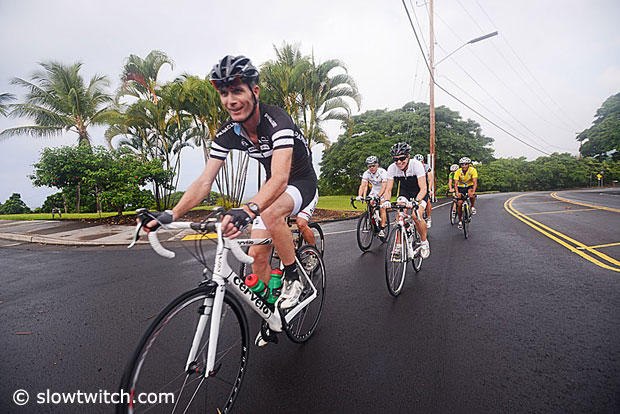
Group ride in Kona, Hawaii heading to the Kaloko climb. Picture - Tim Carlson/Slowtwitch

I've been lucky. All the way along, whether I was a runner, a triathlete, a cross-country skier or a cyclist, I have always had the opportunity to regularly train with people better than me. . . in some cases a lot better than me! I believe that to a large degree, this has been an important part of the, "success" that I experienced along the way, no matter what I was doing in endurance sports.

It's not all absolutely worked out that way. It took me a number of years to figure out the dosing on this. For example, when I was a runner, of some note back in my teens and early 20's, I ran with these better people almost every day. Every workout, particularly hard intervals sessions and tempo runs was like a race! In fact, I probably had some of my best "races" in workouts! Even easy days, were hard!

I recall one session of 7 x 800m intervals on the track that was a 5000m race simulation workout that, was run at a pace way over my head, with a rest session much too short for me to recover. This was a group of  eight or nine strong runners that included, Provincial and National team champions, and team members. Never-the-less, I grimly hung in there, and when my turn to lead, in the lead rotation, came up on the 2nd last interval, I was able to hold the lead all the way, and nail the pace and the 800m split to the second . . . nearly killing myself in doing so. I some how managed to survive the absolute last 800m, but was well off-the-back of  the group in the final 100m. I never duplicated that, "performance" in an actual 5000m race!

As I moved onto triathlon, the situation was the same - regularly training with the absolute best people around in my area and nationally. Ditto with nordic skiing - which became my winter "off-season", from triathlon, but also involved some mammoth ski training, again, often with really good skiers. However, now I was starting to understand better my own needs for periodization - when to load it up and when to back off. When to go hard and long with the group, or when to go easy and do my own thing.

However, it was not just the red-line on the rivet training that, is impactful when you train with really good people, often it's the little things you notice about a world class athlete: How they move? What they wear? What they look at? What's important to them . . and so on.

I have mentioned here before about riding with former Pro Cyclist Alex Steida back in the early 90's in Vancouver. Sure, the riding with Steida was fast, but when you sat on his wheel or road beside him in the group, it was, how at ease he looked no matter what we were doing, that I always noticed. The reach back to grab an energy bar out of the rear pocket of his cycling jersey. Having a drink of water from a water bottle - it all had this extraordinary economy to it all. Grace and calm under pressure!

I recall a run at Christmas time one year in Victioria, BC, with Peter Reid who had just won the first of his three Ironman World Championships two months before, and a young Simon Whitfield, who was just over a year away from winning the first ever Olympic Gold Medal in Triathlon at the 2000 Sydney Olympic Games. The pace for the 16 K run was decent, but not overly fast - in fact Reid had advised us that we had to run "slow". The conversation, was non-stop, and, almost never about training or triathlon! Light and easy. I learned a lot from that run.

Today, my best days as an endurance athlete are far behind me. I don't race much, if at all. Cycling is my thing now. Again, I am lucky in that when I do go out for a group ride, with our local cycling club, the group is peppered with some impressive talent with some of the best Master's cyclists in the province, and in all of Canada! Just hanging in with these guys, and not getting dropped is an achievement and an honor!

Some seek the solitude of solo training. I do too. This quiet time away from everything, I have always found helpful - in many different ways. The trick as I mentioned, is balance. When I was a teenager, running, it was unbalanced towards the side of too much, group training at too high a level. Later on, I realized, how to better balance it all, to get full advantage of the opportunities that training with other better athletes would give me.

The higher level message and take away here is that there is a lot to be gained and learned from training with people who are better than you. I know that I have benefited from it, greatly over the years. Probably did a bit too much of it when I was runner, and had a more balanced approach with it as I got older. But, perhaps I would not have run as well as I did, or developed the massive base of fitness that all that running did for me had I not run like that for 5 - 6 years. Hard to know.

Used properly, group training with better athletes can be highly effective in bringing out the best in you. Don't shy away from it.

Do you train with better people?

If you like what you see here, please feel free to share this blog with your preferred sharing app from the buttons below:

Sunday, December 23, 2012

Merry Christmas 2012


Paolina and I would like to wish all our family, friends and online followers a Merry Christmas & Seasonal Greetings. 

Safe travels and training wherever you may be! 

It's been a great year. We have much to be thankful and grateful for.

Onwards to 2013!

Thursday, September 6, 2012

What a Week? And a Tale of Temptation!

The shocking revelations in the sport of cycling just keep coming. What a week it's been? Of course if we had really been paying attention, we would have known or suspected much of this, so really it should not have come as much of a surprise.

Everyone has their limits. Real competitive sport at the elite high performance level is ruthless - endurance sports like cycling, particularly so. You either keep up . . . or you don't! When you reach that personal limit, when you know you have trained as absolutly as hard as you can and you still can't keep up, or perhaps the podium, is only a few minutes, seconds or steps away . . . . then what?

Maybe I was lucky. I always trained with guys who were a lot better then me - first in running and then in triathlon. Early on in the game, I knew that despite all the training, despite all the hard work, even though we did all the same work outs, there was no way I was going to beat the better guys that I trained with. Call it defeatist if you like. To me it just seemed to be reality.

In the early '90's, I was deep into triathlon. I had come close to breaking 9 hours for the Ironman a couple of times. I was training what seemed to be a crazy amount - kept wondering, if this was my limit. Had a reached the point of taking this as far as I could go? Nine hours at the time was an OK time, but to really break-though, you needed to go sub-9 to be taken seriously. Some potential sponsors had even said, "Call me when you break 9"!

Around that time, I was working out at a local gym and fell into conversation with a coach (note he was not a triathlon coach, but a strength coach who worked out of that gym) who I knew, and helped athletes with strength training. He said to me in a quiet moment of conversation one day, straight-up, that I would be the perfect candidate for a low dosage steroid program. Super-lean (read - skinny-bean-pole) endurance athletes like me, did well on these programs. It allowed us to recover quicker from really hard workouts and made us overall more durable. Meaning, able to train more at a higher level, and then go faster. There was no testing at all in triathlon, the coach said. It was the ideal situation, he concluded!

It could have been that easy for me. In Canada at the time, we were still reeling with the hangover from the Ben Johnson Seoul Olympic Games debacle. Taking steroids, was a no-no. I soon moved, never went back to that gym and never saw that coach again. I did not succumb. I continued to believe that, I could be my best, and get that sub-9 Ironman time, on hard-work and hope.

I tried a few more times, but the sub-9 Ironman remained elusive and by the mid-90's, I had moved onto others things and after my son was born in 1997, gave up on the sport at a competitive level completely.

Given all the news and the revelations this week, I keep thinking back to those days in the early 90's, and that conversation at the gym. How beat-up, battered and fatigued I was after heavy training, and how one conversation and the outcome could have changed everything.

Not making excuses for professional cyclists, but the pressures right through the peleton that they face, would I assume be significantly greater than what me, the sub-pro triathlete was facing in the early 90's. However, everyone will reach their limit, and when they reach that point, knowing realistically, that just more years of hard work is not going to do it, that's perhaps when you reach that junction in the road - one road, is more hard work, but you know not much is going to change. The other road, is to seek some form of outside illegal assistance.

The question is, what road do you take? If you are an endurance athlete, at the level I was at (or there abouts), where you ever tempted along the way?

If you like what you see here, please feel free to share this blog with your preferred sharing app from the buttons below:

Friday, August 17, 2012

Three Ironmans. Three Weeks. Three Very Different Events


 On the run course at Ironman Canada. Photo from IMCGuide.com

In the span of three weeks, the World Triathlon Corporation(WTC) will be putting on three Ironman races in three very different event venues, that represents the past, the present, and possibly the future of these races.

Last weekend was the inaugural Ironman New York City(IMNYC). In truth, most of the race took place across the Hudson River, in New Jersey, but still, the race did have a geographical and actual connection with the Big Apple, in many ways. This race was seven years in the making, and was being billed by the WTC as a showcase for the sport of triathlon and their iconic Ironman brand in one of the key media centers in the world. Veterans in the sport, in particular, those involved in event management knew that this was a massive logistical undertaking, that went way above and beyond what is "normal", for an Ironman triathlon -  which even in the best circumstances, has huge logistical challenges. Read more on this, from the perspective of IMNYC Race Director John Korff, HERE

From many reports the first IMNYC, was reasonably successful. However, no surprise there were a number of logistical hiccups: athletes with non-favorable stories from the course, and more than a few that were saying, one-and-done, and that they would not recommend others doing this race to others. As for media exposure, the big news coming out of the event was a sewage leak up-stream on the Hudson R. that was threatening, even having a swim, and an unfortunate death of an athlete that took place during the swim. Doubtful that this was the media pop, the WTC was hoping for. Registration was opened for 2013, with a $1200 entry fee - about $400 beyond the entry for most other Ironman races! However, the WTC abruptly stopped the registration after a day. The reasons for this, at this stage are unclear.

Despite criticism that they don't care about their race participants, the WTC obviously does take this seriously, and it was clear that the overall consensus from athletes was that, there were some things that needed to be worked on and edges smoothed out at IMNYC. Also, and this is purely speculation at this stage is that, without the benefit of a post-race de-brief, and review, the WTC may have had no idea if they could secure the permits that they had in place for this year, for next year, or if changes to the course were required, get new permits in place.

Key Point - putting on a large triathlon for 2500 people over an Ironman distance course in, and near-by the largest city in North America, is an extraordinarily difficult challenge.

One week from now is the Ironman Canada(IMC) triathlon in Penticton, BC. I have written about IMC before in this space, and you can read more about my personal feeling for the race HERE. IMC is one of the worlds original Ironman triathlons. At one time it was the only Ironman in all of North America. Ever since triathletes first started coming to the Okanagan Valley to do this race back in the 80's, athletes have raved about the beauty of the area, the challenge and scenery of the courses, the hospitality of the town of Penticton, the set-up of the race and ease of it all for athletes and spectators. Back before the proliferation of Ironman races, many had said, IMC, was a better race in some ways, than Ironman Hawaii - The WTC's centerpiece event, their World Championships and the race that started it all! Such is the popularity of IMC that in on-line polls that I have seen, IMC is often the one Ironman race that triathletes, "most want to do"!

Similar to real-estate what's key to a great triathlon and an Ironman race in particular, as told to me by one prominent Race Director, it's "Venue, venue, venue"!

The venue, set-up and logistics of IMC were so good that, Graham Fraser, who took over the management and running of IMC in the mid - 90's, essentially used, IMC and what went on in Penticton as a template, as he expanded the Ironman races to a number of other locations in North America. Now, in truth, IMC did grow in size and sophistication, in an organic fashion over a number of years. Thus, both the race and the city of Penticton grew together and adapted to one another. However, despite all these good things for and about the race, and the city of Penticton, there  have been points of friction, and issues locally, as their have been in some of the other Ironman locations.Mostly regarding the size of these events now, and the disruption they cause. But overall, IMC and those second generation Ironman races, have been very successful, and have a positive impact (financially, in particular) on the towns and cities where the races are held!

Key Point - The best set-up and location for these events is small to mid-sized towns and cities, where you have close to 100% buy-in and support of all stake-holders. Historically, with some exceptions, this does seem to be the case in North America. In the past, this has been the best model.

This weekend is the inaugural Ironman Mount Tremblant ( IMMT) in the ski resort village of Mt Tremblant, Que., about 90 minutes drive north of Montreal.  This Ironman race, despite not even happening yet, is most likely to be a huge success on all fronts. It had the benefit of running one of the WTC's 70.3 races on almost exactly the same course back in June as a bit of a dry-run for this weekend's full Ironman. The reports back from athletes and spectators in June, were unanimous - maybe the best long distance triathlon venue in the world! Useing the "Venue, venue, venue" mantra, IMMT seems to have it all - scenic and challenging courses; tons of great accommodation right there; easy onsite logistics for athletes and spectators; great local hospitality and help; total buy-in from all stakeholders. What's not to like?

Key Point - Perhaps the growth model for the WTC and for Ironman races is finding those perfect race venues such as in Mt. Tremblant, and not trying to put a square peg in a round hole, such as what happened at IMNYC. Does a set-up like at Mount Tremblant this weekend, represent the future of these sorts of events?

If you have done an Ironman, what is your favorite Ironman race venue? If you know of a place, that you think would be a great Ironman race venue, where is it? Or perhaps, on second thought, you may want to keep that a secret!

If you like what you see here, please feel free to share this blog with your preferred sharing app from the buttons below:

Monday, July 23, 2012

Simon Says: The Medals, London and The Legacy

Simon Whitfield at the Toronto Triathlon Festival. Photo by Bob Hatcher - MySportShooter.com


I was living in Vancouver, BC back in 2000. A small group of the Vancouver triathlon community gathered to watch the inaugural Olympic Games Triathlon in Sydney at a well known downtown pub.

Going into the Games, Vancouver's Carol Montgomery had been on fire on the World Cup circuit. Indeed, prior to even getting to the games Carol had accomplished an unprecedented feat in modern Olympic sport, which I don't think has been duplicated - she had qualified in one Games for two different sports. Triathlon obviously, but she had also qualified in Athletics in the 10,000m on the track for Canada as well, and was set to race in the 10,000m final for women on the track later in the games after the triathlon.

We settled into watch history in the making and fingers crossed - witness a win or at the very least, a medal for Carol and Canada. Alas, it was not to be as Carol crashed on the bike, broke her wrist, and was unable to go on. It also took her out of the 10,000m race on the track. We all left the pub a bit disappointed that night.

The next day was the men's triathlon.  For this race I found myself watching on TV with my three year old son, Matthew in the basement of our house, alone other than the two of us. We all know the outcome to this - Simon Whitfield raced to a gold medal, and into, not just triathlon history but into the history of sports in Canada in a big way!

When I realized that Simon had won, the tears started to pour out of me in a completely uncontrolled manner. My son, sitting on my lap, asked, "Dad, why are you crying"? I said, "Simon just won the Olympic games triathlon and the Gold Medal", as I sat there on the couch over-come with emotion. I am not sure if Matthew understood the massive significance of this.

In Canada, this was not just sports news, it was front-page-of-paper, lead-story-on-the-TV-news, news! In fact, a few days later, I was asked on as a guest on the CBC TV Morning News show, to comment on the significance of Simon's Gold Medal win and what it would mean for Canada and for the sport of triathlon.

In a way, we (the sport of triathlon in Canada) were not really ready for it - suddenly all eyes were on Simon and the sport of triathlon. This level of attention and exposure for the sport was completely unknown. But on the whole - looking back, it was the best thing that could have ever happened.

A lot has happened in the ensuing 12 years. Simon, "The Kid", who won in Sydney is now nearer to 40. He won another medal, Silver, in perhaps in even a more stirring and dramatic fashion, four years ago at the Beijing, Olympic Games. The sport of triathlon in Canada has grown up a lot and matured in Canada and elsewhere. We now have a history, and knowing Simon well, one of the things he is most proud of, is a legacy that is starting to build in Canada, because of his success - people take the sport seriously, and some of the current top talent in the country, in particular Multiple World Cup winner, Paula Findlay and a fellow London Olympic Triathlon team member, are a direct result of that legacy.

The ultimate symbol of this, occurred a few weeks ago when Simon was named the Flag Bearer for the Canadian team at the London Olympic Games opening ceremony. Wins and medals aside, there is really no greater honor than to be recognized by your fellow sportsmen and your country. No doubt a proud moment for Simon, and his family, but also for the whole sport of triathlon as well!

This is important stuff - this winning, these performances, the medals, the exposure, the legacy, the pride. I was a guest speaker at the Timex Triathlon Team launch back in February this year. In my remarks at the team dinner and awards, I said, that I really hoped that the United States, could win a  Gold Medal in triathlon at the Olympic Games - maybe even in London ( with apologies to Simon!). It would not only be a big shot in the arm for triathlon, and International Triathlon Union style racing in the United States, but for the whole sport, and business of triathlon - with much of the latter, on the product side, centered in the United States.

Something has not changed since Sydney - that glint you see in Simon Whitfield's eye. It's that slightly mischievous and comedic, look people have when they have something up their sleeve - that he knows something big and important is about to happen. Yet, he's still joking and jovial as ever! That's Simon. I think it's his secret weapon - as it's the polar opposite to the deer-in-the-head-light look of most other athletes at this level prior to the Big Race. I saw that look on Simon, yesterday at the Toronto Triathlon Festival, standing with him on the dock just before the start of the demonstration event that he was doing with Paula Findlay, Andrew Yorke and Mike Greenberg. That means he's ready!

I say watch out, London and make sure that you tune into the  Men's Olympic Triathlon coverage on August, 7th (6:30am Eastern Day Light Saving Time) to watch the final chapter. I know that I will be!

What are your thoughts on the men's Olympic Games Triathlon and what the results will mean?

If you like what you see here, please feel free to share this blog with your preferred sharing app from the buttons below: